
Researching and remembering women in international organisations: the case of UN Assistant Secretary General Helvi Sipilä (1915-2009)
Honourable Helvi Sipilä, Attorney at law, Girl Scout commissioner for Tenderfoot countries, Finnish Representative to the United Nations Commission on the status of women, Past President of FIDA, and one of the nicest girls I have the privilege of knowing!
Raymonde I. Paul, New York, International Federation of Women Lawyers, to Helvi Sipilä, Feb. 1960[1]
A blog post by Louis Clerc
Women in international organisations
Once neglected, the role of women in international organisations has recently become a focus of renewed academic interest. In the case of the League of Nations, women have been studied, for instance, as civil servants[2], members of lobbying organisations working to advance women’s rights, etc.[3]
Recently, Myriam Piguet has worked to parse through the subject from the League of Nations to the United Nations. She has looked at feminised jobs in the Secretariat, typical of organisations where, in Klaas Dykmann’s terms, “[w]omen were employed mostly as secretaries and rarely as officials”.[4] Piguet has also examined the rare high-level positions occupied by women in both the League of Nations and the United Nations.[5]
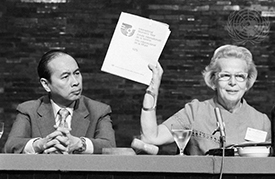
Finding examples of such women in the top echelons of international organisations forces one to move beyond the League of Nations and examine its successor, the United Nations. One such case is the Finnish lawyer and women’s rights activist Helvi Sipilä. Sipilä was the first woman to be nominated Assistant Secretary-General by the UN Secretary-General Kurt Waldheim in 1972. In the secretariat, she was in charge of the Center for Social Development and Humanitarian Affairs until she retired from the post in 1980. She organised the first World Conference on Women in 1975 in Mexico and influenced the United Nations' decision to celebrate the Decade for Women and establish the Development Fund for Women (UNIFEM) in 1976. Sipilä thus dealt mostly with what was considered ‘typical woman affairs’: women’s rights, social and humanitarian affairs, and international development.
Helvi Sipilä, Finland’s first female lawyer
Sipilä’s road to New-York is a good example of how women could reach high positions in international organisations.[6] She was born Helvi Maukola in 1915 in Helsinki, Finland, the daughter of economist Vilho Maukola and Aleksandra Lucinda Manner. The family lived in Häme, in a large farmhouse. Although education for girls was still relatively rare, Helvi’s mother pressed her to attend comprehensive school, and she graduated from high school in 1933. Following that, she went on to study law in Helsinki. Finland was one of the rare European countries where women had the right to vote in the 1930s, and while still a patriarchal society, the country was in the process of opening up possibilities for women to study and work: of the about 2000 new Finnish students in 1939, 40% were women.[7]

Married in the 1930s to the CEO of the pharmaceutical company Orion, Sipilä gave birth to 4 children between 1940 and 1945. Most female law students would end their career upon giving birth, although not Helvi Sipilä. Between 1939 and 1943, the young jurist rose from notary at the Hollola District court to deputy judge and civil servant in Finland’s Supreme Administrative Court. Sipilä was qualified and ambitious, although the context of a world war helped: there was a lack of male judges, most of them fighting on the front against the Soviet Union. Aspiring to become a lawyer, Sipilä was the first woman to open her own law firm in November 1943.
From volunteer work to the UN
In addition to her work, Sipilä participated in the international scouting movement and especially in Girl Scouting. She was also active in international civil society organisations such as Zonta or the Soroptimist International, a global volunteer service for women founded in 1921. Helvi Sipilä's work in both national and international communities led her to take on increasingly demanding assignments in the developing United Nations system. Once Finland became a UN member in 1955, Sipilä represented Finland in the UN Commission on the Status of Women, was a member of the Finnish delegation to the UN General Assembly from 1966 to 1971, and served as Vice-Chairman and Chairman of the General Assembly's Third Committee on Social and Humanitarian Affairs.
With these engagements, her international networks grew – as can be seen from her extensive correspondence, preserved at the Finnish National Archives. This correspondence contains thousands of letters written in a variety of languages, some of them written several times as drafts and corrected.
Sipilä’s selection as UN Assistant Secretary-General
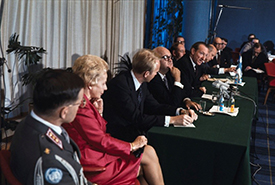
In February 1972, Sipilä’s UN contacts translated into her appointment as UN Assistant Secretary-General. Sipilä’s appointment, although noticed by the Finnish and international press, was seen with ambivalence in Finland’s diplomatic circles. The context was Finland’s failed 1970-1971 campaign to secure the appointment of the diplomat Max Jakobson as Secretary General following U Thant.[8] Jakobson’s bid fell through, and Kurt Waldheim’s proposal to appoint Sipilä at a relatively low position in the Secretariat’s hierarchy was seen in Helsinki as insufficient compensation. This was especially true as the position dealt with tasks considered as menial, such as women's rights or humanitarian affairs.[9]
Officially, however, the Finnish Foreign Ministry backed Sipilä’s nomination, the Finnish ambassador in Geneva telling her that having someone in the UN hierarchy was important for Finland.[10]
Sipilä herself hesitated: in her correspondence, she pondered her responsibilities as a mother, the relatively low level of the position, and the fact that she would be forced to close her law practice. In letters addressed to her, her friends underlined the “personal sacrifice” this would represent. Her family, however, supported her decision. In a last-ditch effort to have her nominated for a higher position, the Finnish Foreign Ministry suggested she would use gender equality as an argument to obtain a higher post. Finally, she accepted Waldheim’s offer and was selected in March 1972 as Assistant Secretary-General, Head of the Centre for Social Development and Humanitarian Affairs.
Between the international civil service and links to Finland
While the Finnish Foreign Ministry supported her during the nomination process, she was not considered to be representing Finland during her tenure, and her contacts with the Ministry were minimal. Sipilä’s interests at the UN turned to things the Ministry saw as of little importance: advancing the cause of women, and especially the cause of women in developing countries. Her centre was instrumental in organising the International Women's Year 1975, and she served as the Secretary-General for the First World Conference on Women held in Mexico City.
In her opening statement to the conference, she noted that it was the first intergovernmental meeting at which women formed part of virtually all delegations, and expressed her hope that it would set a precedent for equal representation of women and men in all future international meetings, whatever the subject. A returning leitmotif in Sipilä’s writings is the insistence on seeing the poverty or oppression of women as a collective problem, linked to all subjects. Likewise, Sipilä insisted on seeing the liberation of women as a first step towards the general development of societies as a whole.
In 1980, Sipilä’s UN career ended, and she came back to Finland. Representing the Liberal People’s Party in 1982, she became the first woman in Finland to be nominated as a presidential candidate.
Memory of a “UN feminist”
Sipilä’s stint as an international civil servant remained only a part of her public life as an advocate of women’s rights, activist in civil society organisations, and lawyer. Her activities in civil society organisations, both nationally and especially internationally, were important ways to secure visibility, expertise, access to networks and contacts: in the same way Florence Wilson entered the League of Nations through her activities in the American Library Association, Helvi Sipilä’s activism in international law circles and women's advocacy brought her international contacts.
Sipilä represents well what Jauhola and Lyytikäinen describe as “UN feminism” in Finland and the Nordic countries: a certain way to extend the possibilities of feminist activism in these countries through international organisations and activities, as well as a way to link feminism and development aid.[11] Sipilä carried this specific vision to her work in the UN, insisting on the links between development and women’s rights.
Sipilä passed away in May 2009 at the age of 94. Despite – or maybe indeed because of - her role in international women's advocacy, Helvi Sipilä is little remembered in Finland. She published several books, but there is no biography of her in a Finnish editorial landscape crowded with biographies of diplomats. One of the rare research projects making use of Sipilä’s archives (as well as the UN archives) is a master’s thesis written by Marika Virta in 2027. After her death, Sipilä’s considerable archives were saved through a private foundation and given to Finland’s National Archives[12].
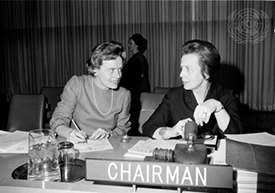
In 2013, it was proposed that the archives should be added to the Finnish Foreign Ministry’s own holdings. During a meeting of the Ministry’s history working group, to which the writer of this blogpost was invited on another matter, the working group decided to turn down the offer. Sipilä, it was said, was not an official representative of Finland, and her archives had no place in the Ministry’s holdings. That small episode represents well the ambivalence with which international civil servants, especially women, are still considered in national settings.
References
[1] National Archives, Finland, Helvi Sipilä archives, Box 2, Kirjeenvaihto 1960-luku.
[2] Eg. Eisenberg, J. “The Status of Women: A Bridge from the League of Nations to the United Nations,” JIOS Vol 4 (2) 2013
[3] Eg. Miller, C. (1992), Lobbying the League: Women’s International Organizations and the League of Nations.
[4] Dykmann, K. (2015). How International was the Secretariat of the League of Nations? The International History Review, 37(4), 721–744.
[5] See Myriam Piguet (2025). High-Powered Assistants: Women in Feminised Secretarial Positions at the League of Nations and the United Nations c. 1920–1975, Almagest, Volume 16, Issue 1, May 2025, 22 – 41. DOI: https://doi.org/10.1484/J.ALMAGEST.5.150959, and Piguet’s 2024 PhD thesis, Women, Gender Equality and Administrative Career in International Organizations, c. 1920-1985.
[6] See Sipilä’s biographical notice in the Finnish National Biography: Forsström, Johanna ja Mäkelä-Alitalo, Anneli: Sipilä, Helvi. Kansallisbiografia-verkkojulkaisu. Studia Biographica 4. Helsinki: Suomalaisen Kirjallisuuden Seura, 1997– (viitattu 15.1.2026), http://urn.fi/urn:nbn:fi:sks-kbg-004426. See also Virta, M. (2017). Naisten asialla – Helvi Sipilä Yhdistyneiden kansakuntien apulaispääsihteerinä 1972-1980, Pro gradu -tutkielma, poliittinen historia, Turun yliopisto.
[7] Vitie, P. (2015). 1930-luvun työssäkäyvä nainen - kolmen naisen kertomukset opiskelusta ja työelämästä
Kirjoittajat, Koulu ja menneisyys, Vol 53: Koulumuistot – kokemuksia koulusta, tutkimusta muistelusta.
[8] Tarkka, J. (2010). Max Jakobson – kylmän sodan diplomaatti, Helsinki: Otava; Pesu, J. (2021). Max Jakobson, Henry Kissinger ja YK:n pääsihteerivaalit 1971, Historiallinen Aikakauskirja, 119(3), 332-347.
[9] The position of Assistant Secretary-General offered to Sipilä should not be mixed with the present day’s position of Assistant Secretary-General. In the early 1970s, there were seven Assistant Secretaries-General, five of whom headed offices subordinate to the Secretary-General, while two (including Sipilä) were assigned to the Under-Secretary-General.
[10] Virta 2017, 17-19.
[11] Jauhola, M. & Lyytikäinen, M. (2020). Kutistettu feminismi? Suomen ulkosuhteiden tasa-arvopolitiikka kylmän sodan YK-feminismistä 2010-luvun tolkkutasa-arvoon. In J Kantola, P Koskinen Sandberg & H Ylöstalo (eds.), Tasa-arvopolitiikan suunnanmuutoksia: talouskriisistä tasa-arvon kriiseihin. Gaudeamus, Helsinki, 150-168.
[12] Jauhola, Lyytikäinen 2020.