
Presenting Georgios Giannakopoulos and The Interpreters
Blog post by Cecilie Rinder Myrup.
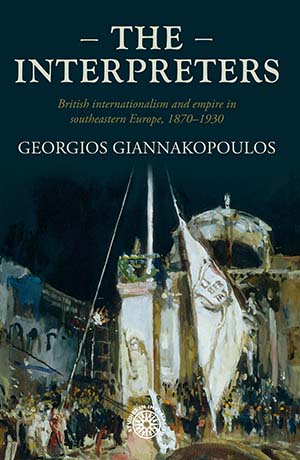
 On 25 February 2026, we had the honour of hosting historian and lecturer at City St. George’s University, Georgios Giannakopoulos, for a presentation on his new book The Interpreters: British Internationalism and Empire in Southeastern Europe, 1870-1930. In connection herewith, we asked Giannakopoulos a few questions, which we will present in this blog along with information given at the presentation itself and some quotes from his interview with Vladislav Lilic on the “New Books in Eastern European Studies” podcast by the New Books Network.
INNER_LEAGUE: What initially motivated you to study the global history of political and imperial ideas?
 Georgios: “My motivation grew out of moving between intellectual environments – studying in Greece, Denmark, and the UK. Experiencing different academic cultures made it clear to me that political ideas are never confined to national borders.
Concepts such as sovereignty, federation, minority rights, and liberty travelled constantly across Europe and beyond. They were shaped not just in London or Paris, but in Vienna, Athens, and Istanbul. The nineteenth century especially revealed how interconnected European political debates were.
I became convinced that to understand Britain — or Europe more broadly — one had to think comparatively and globally. Empires defined themselves not in isolation, but in relation to other empires and smaller states at their edges.”
INNER_LEAGUE: How did you realise the potential in analysing the writings of British scholars and intellectuals who studied Near Eastern empires, as a way to reveal anxieties, problems, and imperial thoughts/ideologies within the British Empire?
Georgios: “The idea emerged during archival research in Britain and continental Europe. I kept encountering British historians, journalists, and public intellectuals who wrote intensely about the Balkans, the Ottoman Empire, and Central Europe. What struck me was that they were never only writing about those regions.
When they debated minority protection in Macedonia or constitutional reform in the Ottoman Empire, they were also grappling with questions central to Britain itself: How should a multi-national polity be governed? What are the limits of intervention? Can liberalism coexist with empire?
I gradually realised that Southeastern Europe functioned as a mirror. Through analysing the “Near East,” British thinkers were processing their own imperial anxieties. That insight shifted my perspective: these writings were not peripheral — they were central to understanding British political thought.”

|

|
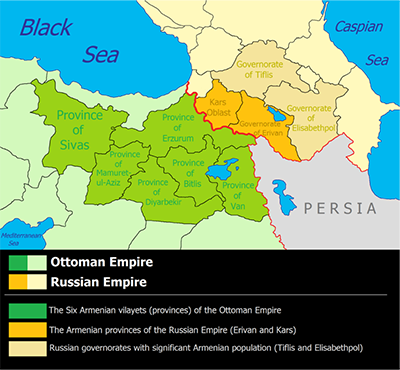
| Though Connelly and Calic use different names for the regions which they study, the geographic area is virtually the same. |
INNER_LEAGUE: How has your historical research & interest changed over the years, and what motivates your work as a historian now?
Georgios: “My earlier work focused on British internationalism and the networks of scholars who interpreted Southeastern Europe. Over time, my research expanded to examine interventions more directly — from nineteenth-century naval blockades and financial control regimes to the IMF crisis of the 2010s.
Today, I am thinking more explicitly about two connected themes: intervention and the language of political freedom. How do powerful states justify involvement in the affairs of weaker ones? How do smaller states respond? And how has the vocabulary of liberty, sovereignty, and democracy evolved in Eastern Europe and the Balkans from the postwar period to the present?
The words we use — “freedom,” “Europe,” “order” — carry long and contested histories. Understanding those histories feels especially urgent at a time when Europe is once again debating its political foundations.
If there is a common thread in my work, it is this: looking at Europe’s margins often reveals transformations in political ideas before they become visible at the centre.
Interview with the New Books Network hosted by Vladislav Lilic
The lives of the book
In his interview with the New Book Network, the author describes the book as having been devised in three phases, which I paraphrase here.
 As a student in Athens, the events in the early 2000s, mainly 9/11, made him contemplate big categories like the East and the West. Around the same time, he also discovered Edward Said and his postcolonial theory, which got Giannakopoulos thinking about how these types of categorisations have been used historically to explain the region of southeastern Europe.
- In Greece, Giannakopoulos wrote his master's dissertation on British historian Arnold Toynbee, who produced theories of civilisations and studied the Greek political tendencies toward violence as the Ottoman Empire fell. Here Giannakopoulos started to link the making of particular regions in the imagination of people and the knowledge production of Greece, Turkey, and the wider region in the Balkans.
- He then moved to England and secured a scholarship from the Greek Scholarship Foundation. Here he reimagined the project that would be, among other things, about knowledge production and international thought: The politics of regional expertise in a wider region, not just Greece and Turkey, but a region defined by empires as they collapsed or disintegrated and the formation of new nation-states.
The book’s thesis and primary arguments
The book’s main intervention revolves around the notion that Southeastern Europe helped British intellectuals - the interpreters - develop complex rhetorical strategies to square these dilemmas of empire, nationality and liberty. The interpreters, in their efforts to make the region legible to international publics, merged their research with Britain’s own political exigencies and questions. The term ‘interpreters’ captures the issue of how different hierarchical powers construct knowledge:
Georgios: “[E]very act of interpretation(...) involves some misunderstanding. So, there is some incommensurability(...) between the person who is doing the interpreting and the actor who is vocalising their own claim, who demands a voice”.
“What I thought was missing from the story, and that is what I tried to do, is to bring the British imperial context together in conversation and, (...) attempting some kind of contrapuntal reading as Said would say, bring the British political context and imperial context in dialogue with what is happening in places like Austria-Hungary and the Ottoman Empire at the end of the 19th century”.
“[E]ssentially(...) problems that we find in empires like Austria-Hungary and the Ottoman Empire are problems that the British Empire also faces in different ways(...) [A] question or an issue that creates a throughline in my story is the Irish question(...) [I]f one thinks about the wider time scale here, we have the beginnings of the Irish question as a problem of imperial rule and nationalism in the mid-19th century: in the 1850s, 60s, most importantly 70s onwards. And this is around the period as well that the so-called Eastern Question comes into a different phase.
Not only did the problem of stability in the Near Eastern empires become acute in the 1870’s, but the problem of imperial and regional order in southeastern Europe, in our case in Bulgaria, also became front and centre in British politics:
Georgios: ”The liberal camp in that period uses this foreign policy problem – massacres of Christians in the provinces of what is now Bulgaria(...) in the political debate against the conservative party”.
Historians of political history and thought usually focus on actors who produced writings inherently about political international history or on actors who had some kind of political role:
Georgios: “What, and especially I think, what historians of international thought or even political thought tend to miss sometimes is what I would call strange kinds of writings; Writings that are about material heritage, writings that produce narratives about civilisation and growth. And this is what I am trying to do with my book. One of the figures I write about is a British archaeologist whose name is Arthur Evans.
“[W]hat we don’t know much about, when it comes to him, is his excavations in places like Dalmatia in the late 19th century, his writings, and his opposition to Austrian rule and Ottoman rule, and the kind of (...) one might say simplistic narratives [of his]”.
“What I claim, using him(...) as a reference point, is that through his lenses, through his practice, we discover strategies of Christianising a region that was far more complex than he made it out to be.”
 By presenting another ‘interpreter’ named Henry Brailsford as an example, a ‘radical’ journalist who became a prominent figure in the Labour Party, Giannakopoulos demonstrates how one can bind together the British Empire and the empires in Southeastern Europe:
Georgios: “[B]y closely examining his writings on Crete and Macedonia, what we discover is a logic of solving problems or discussing problems of imperial governance that, at the same time, he is doing the same things when he is writing about(...) the Irish question and the problem of the Irish peasant. So, in his mind and in his thinking, and Brailsford is a good example of this, the Irish peasant, the Bulgarian peasant, if you will, the Cretan peasant have similar problems”.
“I show in the book how his critique of British imperialism and what the British do in Ireland, to put it that way, kind of connects with his critique of certain regional nationalisms: in Macedonia, what the Greeks are doing to Bulgaria, for instance. I’m simplifying here, but I’m just trying to showcase the kinds of connections that I find interesting. And so far, I find that the kind of literature on this topic hasn’t really(...) unearthed the nuance of those interesting and overlapping rhetorical strategies that address similar questions(...) - managing diversity, solving problems of imperial order, and managing humanitarian crises”-
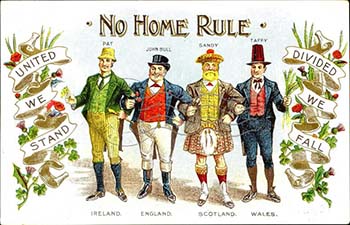
From the 1870, Irish nationalism was on the rise and the people of Ireland began their campaign for home rule. This spured on the Irish question amongst the British of how to tackle the Irish people's call for independence.
Postcard from 1914
Read more about Georgios Giannakopoulos and his work
Get a copy of the book The Interpreters
Listen to Giannakopoulos’ interview with The New Books Network