
Peace or sovereignty? The Sino-Japanese dispute and the League of Nations’ Covenant
Blog post by intern Cecilie Rinder Myrup.
After the Great War had ended and in light of its chaos and the striking disharmony between the peoples of the world, the leaders of the Allied powers France, Great Britain, Italy, Japan, and the US began to dream of a different world order in which the nations united against disturbers of global peace and security. The world needed a peacekeeping organisation. As US President Woodrow Wilson put it in January 1918: “A general association of nations must be formed under specific covenants for the purpose of affording mutual guarantees of political independence and territorial integrity to great and small States alike”.[1]
In this blog post, I examine the dichotomy in the League’s role as presented in the organisation’s Covenant, and how the Sino-Japanese dispute of 1931 influenced and manifested the League’s ‘two faces’, as you might say. I will present the Mukden episode and the aftermath hereof in a case study of Japanese and Chinese rhetoric on the League’s responsibility as a defender of peace and what that entailed in each country’s understanding.
Creating the “covenant of peace”
Though the Allied nations agreed upon the sentiments presented by Wilson in 1918, the configuration of an applicable and harmoniously agreed-upon set of international rules or norms was one of the greatest challenges the League would have to overcome. It became evident to the League of Nations’ founders like Wilson that the initial vision for a “covenant of peace” would have to undergo a compromise if the League was to become a reality. Nations were in conflict over what political state of the world was representative of global peace and order and what national self-determination should entail. Conceptions seemed irreconcilable. The US Congress would, to Wilson’s disappointment, not agree to the terms of the Covenant, and the League would function without the US as a member. Japan would in turn become a hesitant member of the Council, recollecting how the Japanese delegates' suggestion of the addition of an article abolishing the distinction of race in international relations was rejected at the Paris Peace Conference without due consideration. The Covenant could not incorporate every national agenda, and the League would later be criticised for legitimising the political conceptions held by the three great Western Powers of the League, i.e. Great Britain, France, and Italy.[2]
The result of the discussions in Paris was a set of flexible provisions that would in practice change with each unique case brought to the League’s attention. This allowed for potential reservations in the cases brought before the Council. The hierarchy and the power relations inside the League were evident to all members, but belief in the League’s democratic foundations persevered: The Covenant would protect and prosecute nations on equal terms. The age of imperial power was over, and the age of national self-determination commenced with the establishment of the League of Nations, or so it seemed.[3]
In 1931, the League would be tested as a protector of sovereignty as peace in Asia was threatened by a dispute between the Japanese Empire and the Republic of China. Here, the question would be answered whether the League was in fact a challenger of imperial international politics or whether informal inter-imperial accords were still at play behind the scenes in the League.[4]
The covenant on trial: Investigating the Mukden Incident
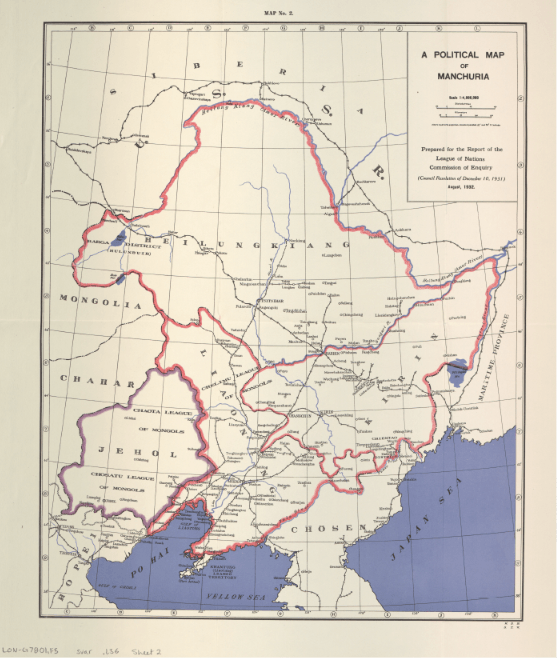
At the Portsmouth Peace Conference in 1905, after the Russo-Japanese War had ended, the Japanese government claimed the Russians' rights to a leased territory in Manchuria, China and the administrative rights over the new railway line that the Russians had established. The Japanese Empire then founded the South Manchuria Railway Company (SMRC), which was a semi-autonomous public company partly run by the Japanese state. An imperial army was stationed in the leased territory of Kwantung in the Liaotung Peninsula and around the railway line zone as a security measure. Many Chinese citizens in Liaotung had harboured anti-Japanese sentiments since the First Sino-Japanese War of 1894-1895, and the government of Japan anticipated civilian acts of sabotage targeting the Japanese railway. By 1930, tensions were rising between Chinese and Japanese citizens in the leased Manchurian territory. Chinese civilians felt that the Japanese SMRC and Kwantung Army were occupying the region on illegitimate terms and feared a complete colonial occupation of their land. The Japanese government hoped that the local issues would escalate so that the Kwantung Army had legitimate grounds on which to take regional control over Manchuria.[5] In the early 20th century, Japan was undergoing a cultural and industrial revolution that was to put its empire on a par with the great Western powers. Hence, Japan had an interest in establishing a colony in China under the Japanese government that could ensure the import of Chinese resources to Japan and prevent the Chinese state from closing trade with Japan as it had done before.[6]
The situation in Manchuria did indeed escalate, fulfilling the wishes of the Japanese officials stationed there. Explosives were detonated on SMRC tracks near the city of Mukden on September 18, 1931. The tracks were not significantly damaged, and the next freight train passed without issues. Still, the Japanese Empire readily accused Chinese rebels from Mukden of the attempted sabotage, and Japanese troops from the Kwantung Army were sent to capture the city and re-establish order in the region. About 500 civilians were killed during the annexation of Mukden. It was later revealed that the culprits had not been Chinese citizens: The ‘attack’ was actually a false-flag operation planned by the Japanese commander of the Kwantung Army without official orders from Tokyo.[7]
China immediately appealed to the League of Nations on the grounds that Japan had violated Article 11 of the League’s Covenant. After China’s delegates submitted their case to the League, the organisation appointed an inquiry commission to investigate the Sino-Japanese dispute, known as the Lytton Commission. Besides conducting its own research into what happened on the 18th of September, the commission would also collect Japanese and Chinese officials’ side of the story. A crucial fact in the investigation became the two nations’ conflicting political ideologies when it came to the perception of national self-determination. China and Japan both felt that the League's role was as a protector of sovereignty and international peace. But what one nation understood by the term national sovereignty, under the new world order, contradicted that of the other nation’s understanding. Neither Japan nor China had developed their convictions about the League and the new world order on a complete fallacy. The inquiry commission of the Mukden incident would reveal the ambiguous foundations of international rules in the League of Nations Covenant. China would place more importance on the first half of the Covenant, especially articles 10 and 11, which conveyed the vision for a new world of peace and equality between nations. Japan, on the other hand, was more inclined to emphasise article 22, to which we shall return shortly. The Covenant was a compromise between two opposed conceptions: That of the old-world order, in which, or so it was imagined, every country could wage war on one another unchecked, and that of the new world order in which the League would take on the responsibility of preventing states from interfering with the sovereignty of other states.[8]
Examining the League of Nations Covenant
It was stated in articles 10-11 of the Covenant that the League members would respect each other's territorial integrity and political independence as well as protect their fellow members against external aggression. If a nation declared war or threatened the independence and integrity of another nation, the League would see it as a matter of concern to all members and would take action.[9] In case a member did not cooperate with the Secretary-General and the Commission during an investigation, the member state would ipso facto be considered to have committed an act of war against all the members of the League, as was stated in Article 16. This would mean a severance of all trade and international relations between that nation and all other member-states.[10] These were the Articles that the Chinese delegates referred to when they requested the League’s help in resolving the situation in Manchuria after the Mukden episode. The Covenant made sure that Japan could not escalate the situation or declare war before an unbiased commission had heard both sides, uncovered the facts of the situation, and determined who the aggressor was.
On the other hand, Article 22 stated that there were certain exceptions to what the League considered an aggression upon state sovereignty. The ideal of international peace could not be secured without the sovereignty of some states being subordinated to that of others. Colonial empires and their forced control of other nations were legitimised in the Covenant’s Article 22. According to the imperial governments, many colonies did not yet have the infrastructure and resources to establish an independent, democratic government, and their state would prove unstable were they to become sovereign nations. The League declared it the organisation’s duty to ensure the well-being and development of the peoples of these regions as part of a “sacred trust of civilisation”. Mandatories or Mandatory Powers, i.e. advanced nations and members of the League, were formally charged by the League to take on advisory or administrative responsibility over one or several Mandates. The help provided to peoples deemed vulnerable would allegedly aim to improve the health and welfare of citizens, but the Article also stated that the Mandatories should secure “equal opportunities for the trade and commerce of other League Members” with the concerned territory.
These Articles represent the conflicting agendas held by the League’s members. The organisation claimed to be a guardian of peace and protector of all nations, great and small, but it was founded in a period of transition when empires still held significant power globally as well as in the League as members, since the organisation was dependent on the major European powers' willingness to use their military. And so, the League had to be built on a constitution that accommodated both old and new world views.[11]
Analysing the Japanese and Chinese rhetoric on the League of Nations
During the League Secretariat Director’s meeting on March 29, 1921, an essay by Chikao Fujisawa was distributed to the Under Secretaries-General and Directors. Fujisawa had studied law at Tokyo University with an interest in international politics, which drew him to the League of Nations. He was appointed to the position of official in the Information Section of the League Secretariat in early 1920. His essay with the title “The present attitudes of Japan towards the League of Nations” attempted to influence the League’s decision on what was to happen to the German concessions in China, specifically Shandong, after the Great War. The essay reflects the strained relationship between Japan and the League as well as the difference between Japan’s self-perceived status and the reality of its place in the League.
At the Peace Conference, a Japanese proposal for an article in the Covenant that abolished “the distinction of race in international relations” was rejected by the other Great Powers. In Fujisawa’s words, this action “caused great disappointment to the Japanese people, who regarded the Conference as embodying the very spirit of international democracy”. Though democracy and equality between nations were one of the visions Woodrow Wilson had for the League, it was never described as a League mission in the Covenant. In the minds of the Japanese, sanctions against racial discrimination would be an acknowledgement of the equal status of the Japanese Empire with the Western imperial Powers.[12] However, the Japanese were treated differently than the Western members of the Council. The USA, though never joining the League, were granted an exemption for the Monroe Doctrine as it was safeguarded through Article 21 in the Covenant; a doctrine that prohibited European intervention in the US sphere of interest in the Western hemisphere. Furthermore, the question of Shandong was resolved at the Washington Conference in 1922, where the German territories were formally given back to the Republic of China. At the same conference, a perceived Western favour towards the Chinese became apparent to the Japanese as the territorial integrity and sovereignty of China were indisputably guarded through the Nine Power Treaty. Fujisawa explained how, since Japan was under an industrial transformation, the country “must resort to China for the supply of raw materials”, and that Japan in return could do something good for China. The Nine Power Treaty was, from China’s perspective, a special security measure against Japan, which should now be deterred from taking further Chinese territory.
In the eyes of the League, all nations were equal, but some were more equal than others, to use George Orwell’s later phrasing, and Japan saw itself as one of the ‘more equal’ nations with imperial claim over Chinese territories. The founding nations behind the League were major colonial powers: France had French West Africa, Italy was expanding its African empire with Libya in 1912, and the British Empire had never been larger in 1921. The Japanese delegates were disappointed when they did not seem to hold befitting power in the Council as representatives of a nation at the top of the League hierarchy. In the end, Japan did not receive the same consideration as a member of the League as other imperial powers did because Japan was not as firmly established as the European empires were.
Eleven years later, Fujisawa became an adamant proponent of Japanese imperial policy. He argued that Japan was the true guardian of what he called ‘the Asian orient’ and Manchuria was just part of Japan’s grander political ambitions. Fujisawa defended the Japanese interference in Manchuria by referring to the unequal political and economic structure of the world where some nations harboured all the natural resources while others were unable to procure enough for their development.[13] The people and the nations of the world were in disharmony, and Japan was therefore at hand to take on the responsibility of combating disorder in Asia through ’oriental philosophy’. Any argument of a Japanese cultural and imperial imposition upon the Chinese was disputed by Fujisawa, as the fundamental guiding principle of the new Manchurian state of Manchukuo, a Japanese puppet state, was "the Way of Sage-King", which was an essential teaching in ancient Chinese political-moral philosophy.
In August 1932, Japan’s foreign minister Count Uchida held a speech to the House of Peers at the opening of the imperial Diet session. The speech consolidated Japan’s policy concerning Manchuria. Here Uchida stated that the Japanese government was following standard procedure for dealing with unstable states and threats to national security. He argued that “Japan's action is essentially identical with the action that other powers have taken elsewhere in similar circumstances”. One example hereof was the Jallianwala Bagh massacre when British troops opened fire on around 10,000 civilian protesters, killing many. It would be, the Japanese argued, the hypocrisy of the League to condemn Japan's actions, as the European colonial powers were not themselves innocent of taking violent measures against insubordinate citizens in their territories.
On the 28th of August 1932, the Chinese Minister of Foreign Affairs Dr Lo Wen-kan, also known as Luo Wengan, delivered a speech at the Chinese Ministry of Foreign Affairs.[14] The speech was a response to Count Uchida’s address to the Diet a few days earlier. Luo Wengan declared the Japanese claim of self-defence in Manchuria a misconstruction of the Covenant. Uchida had presented such an interpretation of the Covenant that would set Japan free from any accusations of wrongdoing, as Japan did not only adhere to the Covenant but was taking an active role in the League’s mission: The achievements of the Manchukuo government, as Uchida presented them, were equivalent to those endeavours listed in articles 22- 23 of the Covenant. In the Japanese understanding, Manchuria was not under the same rights of sovereignty as nations like Japan, but was comparable to a League mandate under the administration of a mandatory. Lo Wen-kan remarked in light of Uchida’s claims:
Japan has now defied the whole world - the League of Nations, The Anti-War Pact, The Nine Power Treaty and other International commitments, and finally the public opinion of mankind.
There appears, when we compare the two speeches, a dispute on the significance and meaning of article 22. Applying the article liberally, Japan could and would argue that they were saving the Manchu people from poor conditions and improving the region's economy. Lo Wen-kan refuted the warped statements of Uchida in this manner: “As for commerce and industry in Manchuria, they have been steadily on the decline since Japanese occupation and in fact never have the economic conditions in that region been worse than they are at present”. In no way was the occupation of Manchuria improving the lives of the Chinese citizens, as was the Mandatory’s responsibility.
Uchida also indicated that the state of China was in disorder and the government unable to undertake its responsibilities to its people. Uchida claimed that Japan, in taking over Mukden and supplying the Manchukuo state with Japanese soldiers, was simply undertaking the administrative role of an advanced nation. Again, Lo Wen-kan had faith that the League would see the Japanese’ actions as an infringement and, if not a violation of state sovereignty, at least a non-compliance with ordained legal procedure. China was not a mandate under Article 22, and Lo Wan-Kan believed that the League would show Japan and the world that the sovereignty of nations was not to be questioned or compromised for the sake of imperial interests. In the end, the League would see the occupation of Manchuria and the Manchukuo state as a transgression of the Covenant, and the Japanese troops were asked to leave China in 1933. Almost immediately after, Japan decided to withdraw from the League.
Conclusions: Assessing the League’s political ideology
China and Japan each appealed to and used the League of Nations Covenant to plead their case after the Mukden incident. Comparing Articles 11- 12 and 22-23, the incident could be interpreted as a threat to international peace or as measures taken by Japan to secure peace. The Sino-Japanese dispute demonstrated how the role of the League was governed by dichotomous interests and objectives. On the one hand, China saw the League of Nations as a protector of states exposed to foreign intervention at the expense of their sovereignty and had faith in the organisation to protect China. On the other hand, there was Japan, which saw itself as a Great Power on a par with France, Italy, the United Kingdom, and the United States. But Japan was, as you might say, a little late to the party of empires. The Japanese had only recently stepped onto the world stage as a Great Imperial Power, combined with its long self-isolation from the West. It appeared at the time as if Japan had not noticed that a new international policy was underway. But Japan was in fact adopting a colonial ideology resembling that of imperial Belgium, France, Germany, and Great Britain, just as a global decolonisation was set in motion and the Western liberal world thought that colonial imperialism was becoming an ideology of the past. The League of Nations took a stance with the formal condemnation of Japan’s actions in Manchuria. In retrospect, the Council jeopardised the peace in Asia and the world as it neglected to check Japan’s evolving imperial policy and strong military force.
Bibliography
Primary sources
-
Chang, Carsun C.: “The decision of the Paris Peace Conference on the Shantung Question defers China from joining the League of Nations”. From the League of Nations Archives, folder name: China and the League of Nations. Created 1919.07.15. (Ref. code: R544/11/337/337)
-
Fujisawa, Chikao: “The present attitude of Japan towards the League of Nations”. From the League of Nations Archives, folder name: Minutes of the Directors' meeting, nr.11 held on March 29th 1921. (Ref. code: dirmtg-11-1921_en)
-
Fujisawa, Chikao: “Manchukuo and a Renaissance of the Oriental Political Philosophy”. From the League of Nations Archives, folder name: Sino-Japanese dispute - Briefing notes on Manchuria submitted to the Inquiry Commission. Sent to Lord Lytton 8 August 1932. Pp.91-127 (Ref. code: S34-34-1-2)
-
From the League of Nations Archives, folder name: Dispute Japan-China in Manchuria - Documents submitted by the Chinese Assessor. (Ref. code: S32/32/2). 385 pages in total. From here, two documents:
-
“Speech delivered by Dr Lo Wen Kan, Minister for Foreign Affairs, at the memorial service at Waichiaopu on august 28th, 1932”, pp.28-34
-
“Telegram from General Ma Chan-san to the Commission of Inquiry, dated April 12, 1932”, pp.340-347
-
-
From the League of Nations Archives, folder name: Japanese plane bombardment of Hangchow (China), consequences that it brought, and the reasons for occupation of Manchurian state. (Ref. code: S30-30-1).
-
Koo Wellington: ‘Brief Comments on the two Japanese Documents: "A General Outline of Manchuria" and "Histoire de l'Indépendance du Manchukuo"’. From League of Nations Archives, folder: Far East Study Commission - International delegation visit to Manchuria - Chinese Assessor - Correspondence and reports. (Ref. code: S50/50/16)
-
Secretariat of the League of Nations (1938[1933]): The Aims, Methods and Activity of the League of Nations, Revised Edition. Published by Allen & Unwin, League of Nations Publications Department, Geneva.
-
The New York Times: “Uchida’s Speech on Japan’s Policy”, (1932), Current History (1916-1940), vol.37(nr.1), pp.126–128.
-
The New York Times, 1. September 1932: “JAPAN DEFIES ALL, LO WEN-KAN HOLDS; Nanking Foreign Minister Says Uchida View on Manchuria Throws Down Gauntlet. SEES PEACE PACT IGNORED. He Asserts China Will Never Yield an Inch of Her Territory Under Stress of Military Force”. Page 6.
Literature
-
Akami, Tomoko (2026): “From a Judicial Solution to Collective Security: The Manchurian Conflict, the Japanese Imperial State, and the ‘Disappearing’ Permanent Court of International Justice, 1931–1933*.” in The Cambridge Handbook of the League of Nations and International Law, ed. Haakon A. Ikonomou, Karin van Leeuwen, and Morten Rasmussen, Cambridge University Press, Cambridge. pp. 225–48.
-
Cloet, Quincy (2019): “The Inquiry Commission for the Manchurian Crisis”, in Truth Seekers or Power Brokers? - The League of Nations and its Commissions of Inquiry, PhD. Thesis: Department of International Politics, Aberystwyth University Press, Wales. P.180-236
-
Cohrs, Patrick O. (2022): The New Atlantic Order- The Transformation of International Politics, 1860-1933, Cambridge University Press, Cambridge. P.571-649, 903-960.
-
Goto-Shibata, Harumi (2020): The League of Nations and the East Asian Imperial Order, 1920–1946, from the series New Directions in East Asian History, Tokyo University Press, Tokyo.
-
Hata, Ikuhiko & Coox, Alvin D. (1989): “Continental Expansion, 1905–1941.” in The Cambridge History of Japan, Vol. 6, ed. Peter Duus, Cambridge: Cambridge University Press. P.271–314.
-
Pedersen, Susan (2015): The Guardians: The League of Nations and the Crisis of Empire, Oxford: Oxford University Press.
-
Spiller, Roger (2005): "11. The Final War", in An Instinct for War: Scenes from the Battlefields of History, Cambridge, MA and London, England: Harvard University Press. pp. 301- 334. https://doi-org.kb-ku.idm.oclc.org/10.4159/9780674043930-012
Endnotes
[1] Secretariat of the League of Nations (1938) p.20
[2] Cohrs (2022) + Pedersen (2015) + Secretariat of the League of Nations (1938)
[3] Cloet (2019) pp.6-13 + Secretariat of the League of Nations (1938) p.21 + Cohrs (2022) pp.579, 613-818
[4] Akami (2026) p.232, on inter-imperial accords
[5] Cloet (2019) pp.180-236
[6] Hata & Coox (1989)
[7] Hata & Coox (1989) pp.294-309 + Spiller (2005) pp.314-317
[8] Secretariat of the League of Nations (1938) pp.24-26 + Goto-Shibata (2020) pp.1-42
[9] The League of Nations Covenant, Article 11
[10] The League of Nations Covenant, Articles 15- 16
[11] Secretariat of the League of Nations (1938) p.26
[12] Akami (2026) p.227 + Goto-Shibata (2020) p.32
[13] Fujisawa (1932): ”Manchukuo and a Renaissance of the Oriental Political Philosophy”
[14] The New York Times 1. September 1932