
Old Guard, New World: Paul Barandon, Germany and the Fate of the League of Nations
Blog post by Sandra Ricker.
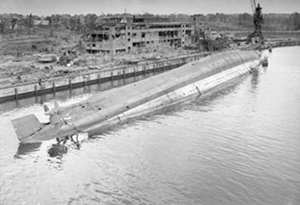
German heavy cruiser ADMIRAL SCHEER capsized in the docks at Kiel after an attack by British heavy bombers. April, 1945. Fotograph by Royal Air Force official photographerby. Reference code CL 2772, from the Imperial War Museum. IWM Non Commercial Licence.
The sky over Kiel can be viciously monotonous in winter. In January 1948, as Paul Gustav Louis Barandon reflected on the international developments shaping war-torn Europe, its marble grey clouds hung over the charred ruins of the port city, where he had spent his youth. It had been a budding centre of German scholarship on the world economy and international law only two decades earlier. He would have remembered the busy docks and shipyards along the Förde and the cobbled streets of the old town. The facades of bombed-out hotels, merchant houses and villas now struck him as the ‘historical cultural document of a lost time’.[1]
A jurist and diplomat, Barandon would have also remembered the internationality Kiel had tentatively embodied before the Nazi takeover of power in 1933. After the military defeat of the German Empire in the First World War, it had emerged as the epicentre of the revolutionary tremors of 1918-1919. The city was also linked to the ensuing conflicts over the new international order as a major port of the Kiel Canal. The stand-off over the conditions of passage through the waterway under the Treaty of Versailles between the Allies and Germany gave rise to the Wimbledon Case, the first case brought before the Permanent Court of International Justice (PCIJ) in 1923.[2] Liberal scholars were involved for some time in the work of the Institute of the World Economy and the Institute of International Law at Kiel University, the first of its kind in the country, founded in 1914. It became the intellectual home of Walther Schücking, a respected authority on the League of Nations. He served as a judge ad hoc at the PCIJ before being called permanently onto its bench in September 1930.[3] The internationalism cultivated here chipped away at the conservative bedrock of the German academic and diplomatic world to which Barandon belonged throughout the 1920s without making deeper inroads.
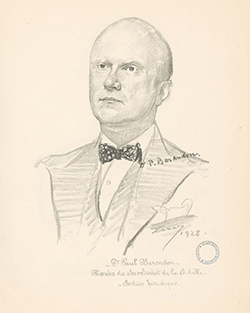
Collection title: Les ouvriers de la paix (The Workers of Peace), 1928. Sketch of P. Barandon by Oscar Lazar from a collection of sketches portraying diplomats and International civil servants in Geneva, 1900-1945. From Bibliothèque nationale de France. Ref. code btv1b10112202k (005 of 136)
In early 1948, Barandon had just completed a preliminary commentary on the institutional foundations of the post-war international order, titled The United Nations and the League of Nations. The new experiment in international organisation hatched in Dumbarton Oaks and San Francisco had captured his interest amid discussions in the reconvened German Society for International Law (Deutsche Gesellschaft für Völkerrecht), where it was seen as a lodestar for the international reorientation of occupied Germany.[4] While the architects of the United Nations (UN) disavowed the League of Nations as its ‘failed’ predecessor, Barandon’s study recorded its quiet presence both as a framework and a foil in the Charter.
He knew the League of Nations intimately. He had been a member of the Legal Section of its Secretariat from 1927-1933 in-between his diplomatic service in the German Foreign Office, reconciling international and national civil service when such institutional migration was novel and politically fraught for officials of the German state, which remained excluded from the League of Nations until September 1926 and withdrew already in 1933 after the consolidation of the Nazi regime.
Amid the rubble of the Second World War, Barandon was left with a complex perspective on international organisation and the development of international law, gained through his diplomatic and legal work in Berlin and Geneva. German disillusionment with the League of Nations had persisted throughout the interwar period. He, however, remained convinced, contrary to German grievances and the wider consensus forming since the early 1930s, that it had not ‘fundamentally failed’. Rather, it had failed by its member states. The ‘popular view’, he insisted, was ‘superficial and aimed legitimate accusations in the wrong direction’ – an unexpected verdict by a conservative German official.[5]
This post explores Barandon’s engagement with the League of Nations and the international legal order outlined in 1919 through his thought and work, revealing the ambiguities of his internationalism across the moments of political change in 1918 and 1945. The arc of his career spanned all of the permutations of the German state in the nineteenth and twentieth centuries, in their deep implication with the two world wars. In this sense, we will approach the League of Nations at a slanted angle, from the troubled German context, where international legal obligations were often regarded as hedged as long as German ‘honour and sovereign equality’ went unrecognised, especially in conservative quarters.[6] The following discussion also serves as a small window into the Legal Section through Barandon’s involvement. Its workings remain largely unexplored in the expanding literature on the League of Nations Secretariat, itself slightly lagging behind the surge in studies of the international organisation more broadly.[7]
Barandon is a particularly interesting historical figure in this context as his career rested upon an interplay of continuity and accommodation under radically different political systems. He spent most of his professional career as a diplomat with conservative leanings. He often discussed international law in this vein, with a certain reverence for the ‘high politics’ of the state, as he liked to put it. In the end, jurists, he remarked in his writings, ‘are required to indicate and interpret the legal forms of high politics’, revealing the ‘path of law’ to politics without engaging in it.[8]
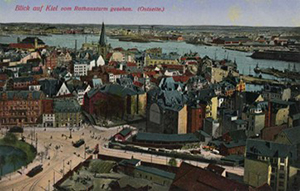
City view from the town hall tower in Kiel, Schleswig-Holstein. Published by M. Dieterle, Kiel, 1905.
He was born in Kiel on 19 September 19, 1881 into a Protestant family with roots in the region and further along the Baltic Coast. His father served as a vice admiral in the Imperial Navy stationed at its naval base.[9] His studies in law took him to Lausanne, Munich, Berlin and back to Kiel, where he completed his doctorate in 1903.[10] After his one-year military service, he briefly worked in the German court system and then joined the Foreign Office in January 1910, working in the Trade Department before taking on duties as vice consul in Rio de Janeiro and Buenos Aires from 1912 to 1913.[11]
His early experience of the civil service and the conduct of diplomacy was thus gained as the German Empire reached the zenith of its international power, its officials chafing against the perceived strictures of an international system constraining German dynamism. When the anticipated war broke out in 1914, Barandon served in cavalry and infantry regiments and as an aide-de-camp on the Western Front. In September 1916, he also fought on the Eastern Front outside of Sibiu (Hermannstadt) against Romanian troops. Upon his decommission in January 1919, he had risen to the rank of reserve captain (Rittmeister der Reserve).[12]
His first months after returning to Germany were quiet, even as (counter-)revolutionary unrest raged and the monarchical imperial state he had served fractured and transformed, a process he would later describe curtly as ‘abrupt and unexpected’.[13] He settled into civilian life as a lawyer and notary in Kiel. A first brush with the international institutional architecture of the Treaty of Versailles soon followed, however, when he was appointed as a German representative on the German-British Mixed Arbitral Tribunal (MAT) in London from 1921-1926, which dealt with private claims, rights and entitlements. Perhaps partly due to the sense of German humiliation surrounding the peace treaty, Barandon was touched to find that he had, as Foreign Minister Gustav Stresemann informed him privately, ‘gained the respect of the adversaries through the legal fight’ at the MAT.[14] It was during this phase that he met Sir Eric Drummond, the General Secretary of the League of Nations.[15]
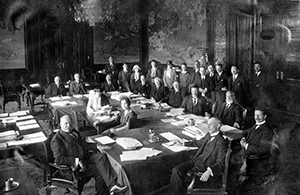
International Court of Justice, the Committee of Jurists at work, assisted by members of the Secretariat of the League of Nations.
The International Committee of Jurists was tasked by the Council in February 1920 with preparing a preliminary draft to serve as a basis for the Assembly's discussions. The draft was presented, and after undergoing some modifications by the Council and the Assembly, it became the Statute of the new International Court of Justice. The Assembly approved this draft at its meeting of December 13, 1920. Picture and notes from the UN Library & Archives of Geneva. Ref. code CIJ11
After an initial swell of enthusiasm for the international organisation and the development of international law in 1919, public estimation of the ‘League of Versailles’ dipped rapidly in Germany as its Covenant became the preface to the peace treaty with the Allied Powers signed on June 28 in the Palace of Versailles. The peace settlement was criticised in Germany as a distortion of the wartime idea of a durable ‘peace of law’ (Rechtsfrieden), veiling Allied power political requirements and decisions in the mantle of universal law and justice.[16] The common aim of revising the Treaty of Versailles, partly by adapting to international changes, mobilised expertise in international law, foreign policy and diplomacy with unprecedented intensity and institutional backing. A separate field of study and activism grew around the League of Nations.
Barandon’s encounter with Drummond, whom he held in high esteem, alongside his friendly relationships with a number of British jurists, including Sir John Simon, proved decisive. Together with his professional qualifications and experience, it secured an appointment to the Legal Section of the League of Nations Secretariat in November 1927. The German Foreign Office readily gave its approval.[17]
The late German entry into the League of Nations in September 1926 meant that Barandon was one of its first German staff members. Despite protests by several states, the Secretariat was still characterised by a preponderance of British, French and Swiss appointees at this time.[18] As studies of the Mandates Section and the Minorities Treaties system have shown, the arrival of German state representatives and international officials led to incisive shifts in the workings of the international organisation, often relying on publicity.[19] However, the activities of the Legal Section, part of its commitment to ‘open diplomacy’ and the codification of international law, were considered among the more technical. They consisted, above all, of providing legal advice to the Secretariat and acting as a link with the PCIJ. Public attention was muted. This was partly owed to the decision of the Legal Section early on to refrain from systematically interpreting the peace treaties, especially in their relation to the Covenant.[20]
This emphasis on technical ‘neutrality’ likely eased Barandon’s professional path into international public administration. He shared common German conservative views of the Treaty of Versailles and broadly ascribed to Stresemann’s approach to internationalism as a form of necessary Realpolitik for a disarmed, diminished state. As a lawyer and diplomat, however, he had an ingrained respect for international law. His scholarship reflected his conviction that the foundation of the League of Nations had marked one of the most crucial transformations of modern international politics and international law, even if he regarded it strictly as an intergovernmental organisation.[21] As a ‘realist’, he insisted on the distinction between ‘positive legal rules and the tendency manifested in the evolution of law’ against more progressive interpretations of the Covenant.[22]
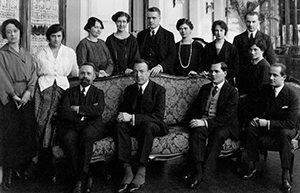
League of Nations Secretariat: Legal Section. Seating (left to right): H. G. Lamba; J. A. Van Hamel (Director); H. McKinnon Wood; Juan Teixidor y Sanchez. From UN Library & Archives Geneva. Date unknown. Ref. code S03
During his seven years in the Legal Section, during which he was voted onto the Staff Committee of the League of Nations Secretariat, he served as a legal expert for several major international conferences. These were concerned with a diverse array of issues, among them free trade, the rights of aliens, opium, whaling, criminal law and arbitration, security and disarmament. In this context, he regularly liaised with civil society organisations from the International Committee of the Red Cross to the International Bureau for the Unification of Criminal Law.[23] His investment in the painstaking international efforts to resolve the interconnected problem of arbitration, security and disarmament also resulted in a major work on the legal machinery of the League of Nations geared towards preventing war (Kriegsverhütungsrecht).[24]
In 1932, the State Secretary in the German Foreign Office offered Barandon a post in the Legal Department, which led him back to Berlin. He recorded with unconcealed pride that his role on the Staff Committee had represented ‘an unusual demonstration of trust in a German’ given the constant background din of international tensions.[25] His return to the capital coincided almost exactly with the Nazi seizure of power on 30 January 1933. On the morning after Adolf Hitler was appointed chancellor, Barandon made his way to the Wilhelmstraße to take up his new position. This period is crucial, as it highlights the extent to which Barandon adapted to, and operated within, the structures of the Nazi regime.
Little documentation on this time in his life has survived. His later reflections in 1945 suggest a general sense of unease with the rapidly consolidating regime that nonetheless smoothly transitioned into active conformity. In his case, this also involved joining the Union of National Socialist German Jurists (Bund Nationalsozialistischer Deutscher Juristen, later Nationalsozialistischer Rechtswahrerbund) and the Academy for German Law (Akademie für Deutsches Recht), where he spoke on the reform proposals for the League of Nations in December 1936.[26] In 1937, as was common among civil servants, he also joined the party.[27] In the same year, he published another book on the international treaty system of the post-war period, perhaps reflecting in part a lingering investment in the international legal structures under attack. However, his approval of certain foreign policy aims of theIn the
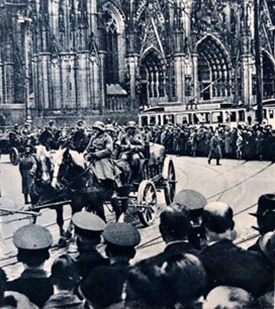
German troops marching into Köln 7 March, 1936. After WWI, Köln was part of the demilitarized zone of the Rhineland, and the German government thereby broke the Treaty of Versailles by remilitarizing cities like Köln in the area. From Wikimedia under the CC BY-SA 4.0 license.
Nazi regime, several of them, unilateral steps that violated international law, were unmistakable. Some of these he considered a necessary part of the restoration of German ‘honour and sovereign equality’, which conservative jurists interpreted and legitimised as the prerequisite for the emergence of a more durable international legal order rather than its undoing.[28] His views in this context underscore the extent of his accommodation with the Nazi regime but also the deeper revisionist legacy of the 1920s.
Barandon began criticising the member states of the League of Nations for hastening its slide into irrelevance. Germany had exited in protest after the deadlock at the Disarmament Conference in late 1933, shortly after Japan had taken the international inquiry into its invasion of Chinese Manchuria as its cue to withdraw. He argued that the erosion of the international organisation was linked with the pursuit of power-political objectives under its cover, which often directly contravened its purposes. With this, he was not taking oblique aim at the Nazi regime, whose ‘parodic’ instrumentalisation of international principles, foremost national self-determination, had gathered pace, albeit outside of the bounds of the League of Nations.[29] Rather, he shared an aggrieved nationalist focus on supposed Allied and particularly French machinations that was characteristic of German conservative commentary. It was the French system of military alliances that he adduced as an example of a security policy that had undermined ‘fundamental principles’ of the League of Nations concerning the prevention of war through mechanisms of collective security.[30]
Eventually, his later recollections hint, the process of Nazi coordination (Gleichschaltung) began to weigh on him to the extent that he agreed to a diplomatic mission in South America from 1937 to 1941. It is difficult to determine to what extent this was a retrospective minimisation of he retrospectively minimized his willingness to acquiesce in the Nazi state.[31] Upon his return to a ‘joyless and sombre Berlin’, he took on official duties as the deputy to the plenipotentiary (Reichsbevollmächtigter) tasked with the civilian administration of occupied Denmark. In November 1942, Werner Best took over this role. In the preceding years, he had been a key figure in the Nazi secret police apparatus at the Reich Security Main Office (Reichssicherheitshauptamt).[32] This position involved Barandon in the oppression and spoliation of Denmark, including a range of crimes against the civilian population, even if his direct influence on actions of the SS (Schutzstaffel), SA (Sturmabteilung) and Wehrmacht as a diplomatic envoy was limited. Often, he was not made fully aware of certain actions as they unfolded.[33]
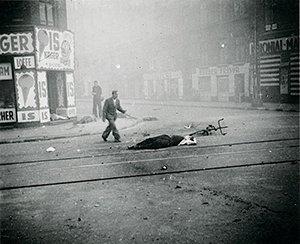
Photo by Ingvar Olsen, 30 June, 1944. A woman and two men lie dead in front of an ice cream shop at the corner of Solitudevej and Nørrebrogade in København after the German occupying power used cannons to disband the People’s Strike (folkestrejken) of 1944. The strike was a key event in the Danish resistance movement of WWII as tens of thousands of people took to the streets on the 30 June to the 5 July in the biggest confrontation between Danish citizens and the occupying power. Frihedsmuseets photo archive, National Museum of Denmark. Ref. code: FHM-171893
According to post-war personal records, he requested a transfer after witnessing a long succession of brutal acts of suppression against Danish civilians and officials, acts of Nazi ‘tyranny’, as he commented. He sought to separate them in their intent, planning and execution from the traditional state ministries, especially the Foreign Office, negating his own culpability. The final months of the war, he spent as the representative of the foreign minister at the Army High Command (Oberkommando des Heeres) in Zossen.[34]
In the summer of 1945, Barandon reunited with his family in Hamburg. Here, he penned his reflections on his time in the Foreign Office under Nazi rule in an effort to ‘account for what has occurred’, an elision clouding the magnitude of the criminality of the political system while also revealing the difficulty of capturing its nature in words in the immediate post-war period.[35] His first thoughts were sharply condemnatory of the party as well as the upper echelons and the main security institutions of Nazi Germany. At the same time, he found various ways to justify what he understood as the acquiescence, at times acclamation of state ministries and German society, transferring questions of guilt onto history. The German nation, he remarked, offering a brief but sharp verdict, had ‘lacked the aptitude to govern itself’ since the formation of the German Empire. Over the following months, until 1947, he was repeatedly interrogated during post-war trials of higher-ranking officials under the Nazi regime in Denmark and Germany, including in the Ministries Trial (1947-1949).[36]
By 1948, Barandon turned to completing his work on the second post-war attempt at international organisation, leading to the creation of the UN. It bore the imprint of his own affiliation with its predecessor, a spectral presence he saw everywhere, unacknowledged in and between the lines of the new Charter. The lingering weight of the end of the League of Nations is tangible in his study in repeated ruminations on its causes. He settled on tracing them mainly to its betrayal by its member states, whose leading officials, he argued, had not found a common political purpose in aligning their foreign policies with its requirements. It was, however, in his view, also the lack of universality from its birth that had deformed its evolution. The United States, the Soviet Union and Germany had skirted their institutions for too long as bitter political disagreements were left unresolved.[37]
His interest in the UN during this time was also owed to the desperate post-war situation of Germany, divided into occupation zones that increasingly appeared as the fault lines of a gathering conflict. Observing the tensions between the Western occupying powers and the Soviet Union, he urged German involvement in the future of the (inter-)national order through ‘constructive and progressive proposals’, such as those by Konrad Adenauer, the leader of the Christian Democrats, for a German ‘bourgeois democracy with a Western European-American imprint’. The Soviet system, he was convinced, could not support German political, moral and economic reconstruction.[38]
This required an anchor in Western European culture, Barandon believed, and the framework of the UN with its articulation of human rights. The considerations that had guided the realisation of the new international organisation had left Germany outside of its bounds with an indeterminate political and legal status.[39] Yet the ‘fundamental idea’, he ventured, ‘we can earnestly make our own’.[40] For all of the distortions of international law by state power, he remained convinced that its tenacious endurance, even the deference states often paid to its authority by invoking it to justify their violations, was owed to an ineradicable human impulse towards law and morality. Their forms would now be collectively determined, he wrote, as had once been the hope placed in the League of Nations.[41] Barandon’s thought and work were marked by continuity and adaptation in the face of political rupture with all of the attendant unresolved tensions, mirroring his own understanding of the League of Nations as an organisation not so much failed as transformed in its afterlife.
Notes
[1] [‘historisches Kulturdokument einer vergangenen Zeit’] ‘Nationalsozialismus, Krieg und Zusammenbruch. Einige Erfahrungen und Betrachtungen’ (Hamburg, July 1945), PA AA NL Barandon 12/7, 22. See also Richard Overy, The Bombing War: Europe, 1939-1945 (London, 2013).
[2] The majority ruling in 1923 set down the view that the exclusive jurisdiction and competences of a sovereign state were delimited by their international legal obligations, in this instance provisions of the Treaty of Versailles overriding German declarations of neutrality underlying the closure of the Kiel Canal to the French-chartered S.S. Wimbledon carrying ammunition and other war materiel destined for the Polish armed forces. Under the given circumstances, this reinforced common notions in Germany that the Treaty of Versailles was not an expression of German sovereignty, as the international judges argued, but the imposed codification of various constraints on its exercise. On the Wimbledon Case, see Władysław Czapliński, ‘The Wimbledon Statement on State Sovereignty, and the Relationships between International and National Law: Then and Now’, in Roman Kwiecień and Malgosia Fitzmaurice (eds.), The Legacy of the Wimbledon Case: Centenary of the First Judgment of the Permanent Court of International Justice (Leiden, 2025), 129-149.
[3] See Ole Spiermann, ‘Professor Walther Schücking at the Permanent Court of International Justice’, European Journal of International Law, 22:3 (2011), 783-799.
[4] Paul Barandon, Die Vereinten Nationen und der Völkerbund in ihrem rechtsgeschichtlichen Zusammenhang (Hamburg, 1948); ‘Die Tagungen der deutschen Völkerrechtslehrer und der Deutschen Gesellschaft für Völkerrecht’, German Yearbook of International Law, 3 (1954), 186-193.
[5] [‘gründlich versagt’; ‘Diese populäre Auffassung ist oberflächlich und richtet berechtigte Vorwürfe an die verkehrte Adresse.’] Barandon, Die Vereinten Nationen und der Völkerbund, 10.
[6] [‘Ehre und Gleichberechtigung’] Paul Barandon, Das System der politischen Staatsverträge seit 1918 (Stuttgart, 1937), 3.
[7] See, however, Bernjamin Auberer, ‘Female Staff in the Legal Section of the League of Nations’, in Immi Tallgren (ed.), Portraits of Women in International Law: New Names and Forgotten Faces? (Oxford, 2023), 286-295.
[8] [‘Aber schließlich sind wir Juristen, denen es obliegt, der großen Politik ihre Rechtsformen zu deuten und zu bereiten. Wir können der Politik den Weg des Rechts weisen. Machen können wir sie nicht.’] Barandon, Die Vereinten Nationen und der Völkerbund, 6.
[9] ‘Fragebogen’, PA AA NL Barandon 12/6.
[10] Personal information submitted as part of the application for membership in the Union of National Socialist German Jurists (1 May 1934), PA AA NL Barandon 12/6.
[11] ‘Fragebogen’ (14. Dezember 1936), PA AA NL Barandon 12/6; ‘Lebenslauf’. Gesandter I. Klasse a.D. Dr Paul Barandon’ (Hamburg, November 1962), PA AA NL Barandon 12/7.
[12] ‘Militär-Dienstzeitbescheinigung’ (Berlin, 21. Juni 1933), Zentralnachweiseamt für Kriegerverluste und Kriegergräber, Büro für Kriegsstammrollen, PA AA NL Barandon 12/6.
[13] [‘schroff und unvermittelt’] ‘Nationalsozialismus, Krieg und Zusammenbruch. Einige Erfahrungen und Betrachtungen’ (Hamburg, July 1945), PA AA NL Barandon 12/7, 2.
[14] [‘[…] mir auch die Achtung der Gegner im Rechtskampf errungen hatte.’] ‘Lebenslauf. Gesandter I. Klasse a.D. Dr Paul Barandon’ (Hamburg, November 1962), PA AA NL Barandon 12/7, 2.
[15] ‘Fragebogen’ (14. Dezember 1936), PA AA NL Barandon 12/6; Lebenslauf. Gesandter I. Klasse a.D. Dr Paul Barandon’ (Hamburg, November 1962), PA AA NL Barandon 12/7, 2. On the Mixed Arbitral Tribunals as a feature of the new international order, see Hélène Ruiz Fabri and Michel Erpelding (eds.), The Mixed Arbitral Tribunals, 1919-1939: An Experiment in the International Adjudication of Private Rights (Baden-Baden, 2023).
[16] This was the title of a widely read study of the League of Nations by Bernhard Wilhelm von Bülow, a diplomat in the Foreign Office who headed its Special League of Nations Section (Sonderreferat Völkerbund) from 1923. See Bernhard Wilhelm von Bülow, Der Versailler Völkerbund: Eine vorläufige Bilanz (Berlin/Stuttgart/Leipzig, 1923).
[17] ‘Lebenslauf. Gesandter I. Klasse a.D. Dr Paul Barandon’ (Hamburg, November 1962), PA AA NL Barandon 12/7, 2; ‘Mr Barandon (Dr., Paul Gustave Louis)’, LONA S710/15/186.
[18] See Karen Gram-Skjoldager and Haakon A. Ikonomou, ‘The Construction of the League of Nations Secretariat. Formative Practices of Autonomy and Legitimacy in International Organizations’, The International History Review, 41:2 (2019), 257-279.
[19] See Susan Pedersen, The Guardians: The League of Nations and the Crisis of Empire (Oxford, 2015); Carole Fink, ‘Stresemann’s Minority Policies, 1924-1929’, Journal of Contemporary History, 14:3 (1979), 403-422.
[20] See ‘Commentaires’ by Joost Adrian van Hamel, director of the Legal Section of the League of Nations (17 October 1919), LNA R1225-17-1740-1740.
[21] See Barandon, Die Vereinten Nationen und der Völkerbund, 15-19.
[22] Francis Deák, ‘Review of Das Kriegsverhütungsrecht des Völkerbundes. By Paul Barandon. Berlin: Carl Heymanns Verlag, 1933. Pp. xii, 406. Rm. 24’, The American Journal of International Law, 28:1 (1934), 187-188, here 188.
[23] See ‘La Guerre Chimique’ (1929-1933), LNA 2364-7A-13831-287; ‘Congrès International de Droit Penal, Bucarest, 6-11 October 1929’ (1929-1937), ‘Administration pénitentiaire’ (September 1932), LNA R3292-13-13117-510; LNA R3582-50-38871-6403; ‘Lebenslauf. Gesandter I. Klasse a.D. Dr Paul Barandon’ (Hamburg, November 1962), PA AA NL Barandon 12/7, 2.
[24] See Paul Barandon, Das Kriegsverhütungsrecht des Völkerbundes (Berlin, 1933).
[25] [‘[…] ein in der damaligen Zeit für einen Deutschen nicht gewöhnlicher Vertrauensbeweis’] ‘Lebenslauf. Gesandter I. Klasse a.D. Dr Paul Barandon’ (Hamburg, November 1962), PA AA NL Barandon 12/7, 2.
[26] ‘Fragebogen’ (14 December 1936), PA AA NL Barandon 12/6. For the talk, see Paul Barandon, ‘Einige Bemerkungen zu den Regierungsvorschlägen und dem Bericht des Generalsekretärs des Völkerbundes zur Reform des Völkerbundes’, Zeitschrift für ausländisches öffentliches Recht und Völkerrecht, 7 (1937), 1-14.
[27] Letter and ‘Fragebogen’ sent from Paul Barandon to the NSDAP Auslandsorganisation, Amt für Beamte (Berlin, 1 and 2 July 1937), PA AA NL 12/6.
[28] [‘Ehre und Gleichberechtigung’] Barandon, Das System der politischen Staatsverträge seit 1918, 3. See also Viktor Bruns, ‘Bund oder Bündnis? Zur Reform des Völkerbundes’, Zeitschrift für ausländisches öffentliches Recht und Völkerrecht, 7 (1937), 295-312.
[29] See Nathaniel Berman, ‘Beyond Colonialism and Nationalism—Ethiopia, Czechoslovakia and Peaceful Change’, Nordic Journal of International Law, 65:3-4 (1996), 421-479.
[30] [‘Grundsätze’] Barandon, Das System der politischen Staatsverträge seit 1918, 3.
[31] ‘Nationalsozialismus, Krieg und Zusammenbruch. Einige Erfahrungen und Betrachtungen’ (Hamburg, July 1945), PA AA NL Barandon 12/7, 4.
[32] [‘freudlose und düstere Berlin’] Ibid. 7. See Ulrich Herbert, Best: Biographische Studien über Radikalismus, Weltanschauung und Vernunft, 1903-1989 (Munich, 2016).
[33] ‘Nationalsozialismus, Krieg und Zusammenbruch. Einige Erfahrungen und Betrachtungen’ (Hamburg, July 1945), 7-16, PA AA NL Barandon 12/7. See also John T. Lauridsen, ‘Paul Barandon: Werner Bests loyale stedfortræder’, in Henrik Lundtofte et al. (eds.), På Førerens Orde: Hitlers mænd i Danmark, 1933-1945 (Aarhus, 2024), 337-353. On the civil servants of the Foreign Office as ‘cooperative perpetrators’, see Sebastian Weitkamp, ‘Kooperativtäter—die Beteiligung des Auswärtigen Amts an der NS-Gewaltpolitik jenseits der Endlösung’, in Johannes Hürter and Michael Mayer (eds.), Das Auswärtige Amt in der NS-Diktatur (Berlin/Munich/Boston, 2014), 197-217.
[34] [‘Tyrannis’] ‘Nationalsozialismus, Krieg und Zusammenbruch. Einige Erfahrungen und Betrachtungen’ (Hamburg, July 1945), PA AA NL Barandon 12/7, 15-18.
[35] [‘[…] versucht, sich Rechenschaft vom Geschehenen zu geben […].’] Ibid. 22.
[36] [‘[…] weil dem deutschen Volk die Begabung fehlte, sich selbst zu regieren.’] ‘Nationalsozialismus, Krieg und Zusammenbruch. Einige Erfahrungen und Betrachtungen’ (Hamburg, July 1945), PA AA NL Barandon 12/7, 1.
[37] See Barandon, Die Vereinten Nationen und der Völkerbund, here especially 11.
[38] [‘konstruktiven und richtungsweisenden Vorschläge’; ‘bürgerliche Demokratie westeuropäisch-amerikanischer Prägung’] ‘Nationalsozialismus, Krieg und Zusammenbruch. Einige Erfahrungen und Betrachtungen’ (Hamburg, July 1945), PA AA NL Barandon 12/7, 27.
[39] See Hans Kelsen, ‘The Legal Status of Germany According to the Declaration of Berlin’, The American Journal of International Law, 39:3 (July 1945), 518-526.
[40] [‘Wir können uns diese Grundidee ehrlich zu eigen machen.’] ‘Nationalsozialismus, Krieg und Zusammenbruch. Einige Erfahrungen und Betrachtungen’ (Hamburg, July 1945), PA AA NL Barandon 12/7, 28.
[41] Barandon, Die Vereinten Nationen und der Völkerbund, 14.