
Mobilising Transnational Expertise
Emmy Freundlich and the League of Nations’ Economic and Financial Organisation [1]
Blog post by Samuel Boscarello (IMT School for Advanced Studies Lucca).
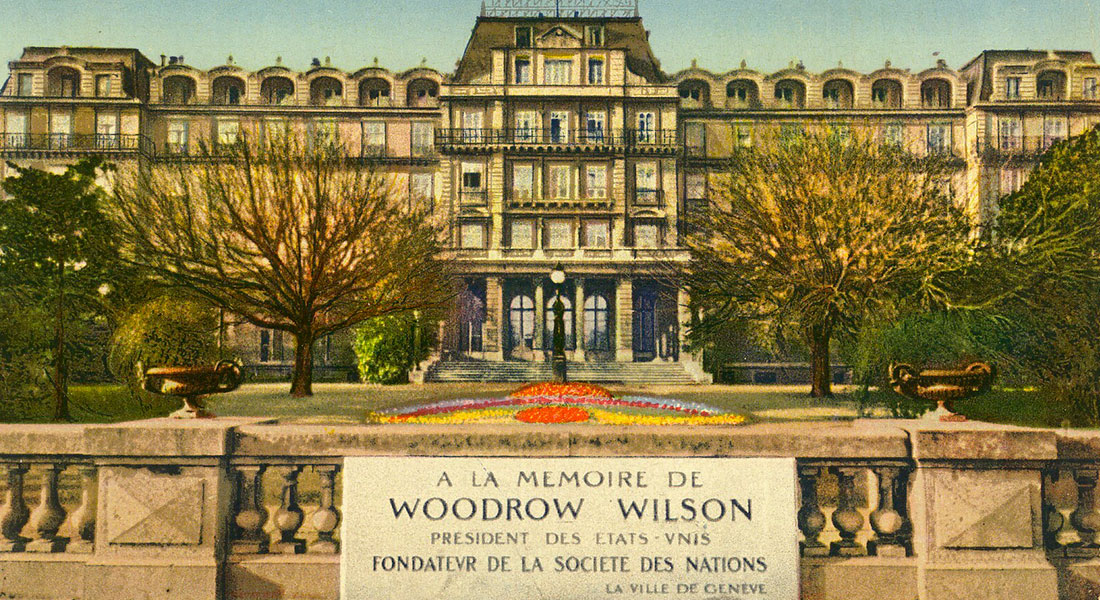
On 23 May 1927, the International Economic Conference convened its closing plenary session in Geneva under the auspices of the League of Nations. In an atmosphere of cautious optimism, Emmy Freundlich, vice-chair of the conference and delegate of the Austrian government, took the floor. In a brief address, she forcefully reiterated what she regarded as one of the conference’s principal achievements: the nascent yet crucial recognition of organised labour and women’s movements as stakeholders whose participation should become a permanent feature of the League’s deliberative processes.[2] Using Freundlich’s trajectory as a point of departure, this blog explores how the League of Nations’ Economic and Financial Organisation endeavoured to mobilise transnational expertise beyond governments, how this strategy reshaped its relationship with organised civil society, and why it ultimately failed in the face of the Great Depression.
A Woman Cooperator in the "Greater League"
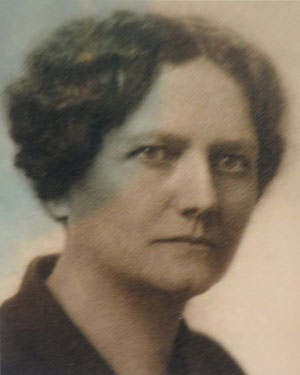 Women’s participation in international economic governance was particularly close to Freundlich’s heart. The only woman delegate at the conference, she had devoted her entire public life to advocating comprehensive reform of economic institutions to improve the material living standards of the popular classes, with particular attention to a constituency that was both vast and largely invisible: women consumers and housewives. Born Emmy Kögler (1878-1948) into a prosperous Bohemian bourgeois family that attempted to steer her towards a conventional path of boarding school education and a socially advantageous marriage, she possessed a restless temperament that led her in a very different direction. Following the death of both parents, she devoted her considerable inheritance to political activism. She became involved with the Social Democratic Party in Vienna, where she met the journalist Leo Freundlich – her future husband, from whom she would divorce in 1912. More importantly, she undertook a rigorous self-education in economics and soon rose to become one of the leading figures of the Austrian cooperative movement.[3]
Freundlich’s biography offers a particularly revealing vantage point from which to examine the relationship between the League of Nations administration and the constellation of non-governmental organisations that gravitated around it – the so-called “Greater League”.[4] Her interactions with the League’s Economic and Financial Organisation (EFO) illuminate the circulation of expertise between the organisation and its wider environment, while also shedding light on how changes in the League’s institutional architecture shaped the production and exchange of knowledge alongside evolving conceptions of global governance during the interwar years. Through this lens, we can observe how the EFO mobilised transnational expertise not only to secure a degree of autonomy from governmental pressures, but also to influence governments themselves. This effort was pursued most vigorously under the leadership of Arthur Salter between 1923 and 1931, particularly through the Economic Consultative Committee (ECC), a body specifically established to encourage governments to honour the commitments made at the 1927 International Economic Conference.[5]
Historians have written extensively about how states strive to shape international organisations to serve their interests. Only recently, however, has scholarly attention turned to how international organisations themselves deploy one of their most important resources – the production of knowledge – to encourage governments to fulfil their international commitments and to maximise the effectiveness of their own actions, often in the absence of coercive means.[6] As we shall see, the ECC’s efforts ultimately proved unsuccessful. Yet its failure stemmed not from the gap between the League’s ambitious public aspirations and its limited capacity to compel governments – as had been the case with the Disarmament Section.[7] Rather, the ECC fell victim to the abrupt deterioration of the international climate following the financial crash and depression starting in 1929. Combined with cumbersome internal procedures, this contributed to a growing sense of institutional paralysis in the face of mounting economic and political challenges. As both a participant in the League’s economic networks and a representative of forms of expertise developed outside traditional academic and governmental institutions, Emmy Freundlich stood at the intersection of the EFO and the transnational civil society. Following her trajectory makes it possible to reconstruct the process that led from the organisation of the 1927 International Economic Conference to the creation of the ECC and, ultimately, to its dissolution.
Freundlich’s Vision of Consumer Democracy
Freundlich’s thinking was deeply shaped by her engagement in Austrian politics and the cooperative movement. Her diagnosis of the problems afflicting global economic governance in the aftermath of the First World War drew heavily on her experience within the consumer cooperative movement and on her direct observation of the dire conditions prevailing in post-war Vienna. The collapse of the Habsburg Empire had been an economic catastrophe. A deeply integrated economic space suddenly found itself fragmented by thousands of kilometers of new internal frontiers, each border creating additional obstacles to the movement of goods and productive resources. The most visible consequence of this upheaval was widespread hunger. It is therefore no coincidence that Austria became a testing ground for new economic paradigms during the 1920s. The country was the first recipient of a League of Nations financial assistance programme, built around stringent austerity measures. At the same time, historians have shown how the economic dislocation caused by the Empire’s dissolution prompted several economic thinkers, ranging from Joseph Schumpeter to Friedrich Hayek and Ludwig von Mises, to seek ways of defending liberal civilization from the disruptive effects of mass politics.[8]
Far less familiar is Emmy Freundlich’s contemporaneous response to the same crisis. Influenced by a political culture situated at the intersection of reformist socialism and liberal pacifism – a current particularly influential within the cooperative movement – she argued that the protectionist barriers erected across post-war Europe amounted to little more than a continuation of war by other means. The result, in her view, was chronic instability within the international economy, a condition that would sooner or later compel economic actors to reorganise themselves. The rise of industrial cartels and trusts appeared to her as clear evidence of this trend. Yet such developments also threatened to strengthen producers at the expense of consumers. The central challenge, therefore, was not to prevent the rationalisation of production on an international scale, but to ensure that it was guided by democratic principles. In practical terms, this meant organising consumers into bodies capable of overseeing industrial concentrations at both the national and supranational levels, thereby safeguarding the public against unfair commercial practices.
Up to this point, Freundlich’s position, while certainly ambitious, differed little from the official programme of the international cooperative movement in the years following the war. What set her apart was her conviction that women should play the leading role in organising consumers. As mothers, she argued, women were responsible for managing household expenditure and were therefore uniquely positioned to represent consumers’ interests. Likewise, she observed, it had been mothers who had performed some of the most remarkable acts of compassion during the war, caring not only for orphans but even for the children of enemy nations in the name of a shared suffering that transcended wartime divisions. Freundlich’s “maternal feminism” – her appeal to women’s maternal role as a foundation for political action – was directed above all towards housewives, a vast yet largely invisible social constituency comprising millions of women who, lacking paid employment, found no representation within the trade union movement. In her vision, consumer cooperatives were the institutions best placed to channel the demands of these women and to act as pioneers in the construction of an international economic order founded on free trade and peace.[9]
Setting the Agenda of the 1927 International Economic Conference
The principal vehicle for this programme of economic reform was the International Co-operative Women’s Guild (ICWG), founded in 1921 to represent women active in the cooperative movement at the international level and chaired by Freundlich herself. Politically, the ICWG was a heterogeneous organisation, bringing together liberal, social-democratic, and communist wings. Not all these currents viewed the League of Nations favourably, but Freundlich nevertheless succeeded in integrating the ICWG into the League’s institutional orbit. Between 1922 and 1925, she repeatedly endeavoured to make her voice heard in Geneva, intervening in debates surrounding the League’s financial assistance programme for Austria, commenting on major international developments such as the occupation of the Ruhr, and engaging with the newly established Advisory Committee for the Protection and Welfare of Children and Young People. These efforts, however, met with only limited success.
The situation changed in 1925, when Freundlich’s ambitions converged with plans to convene an International Economic Conference under League auspices. By then, the darkest years of the post-war crisis appeared to be over, and the moment seemed ripe for a comprehensive reconsideration of global economic governance. Governments were increasingly being called upon to cooperate in freeing international trade from the protectionist disputes that had characterised the immediate post-war period. Responsibility for preparing the conference fell to the EFO, whose director, Arthur Salter, had clear ideas about how its agenda should be shaped. Heading a staff of barely twenty officials, Salter aimed to cultivate around the EFO a community of experts capable of operating independently of their national governments, thereby creating an autonomous transnational space for economic governance.[10]
To this end, in late 1925 Salter promoted the establishment of a Preparatory Committee composed of thirty-five members drawn not only from the EFO and other international agencies, including the International Labour Office, but also from non-governmental bodies such as the International Chamber of Commerce, international trade union federations, and the International Institute of Agriculture. Emmy Freundlich was among those selected, thanks in part to the recommendation of Albert Thomas, director of the International Labour Office.[11] The two already worked closely together as members of the Central Committee of the International Co-operative Alliance, the principal representative body of the global cooperative movement, of which the ICWG formed an important branch.[12]
The Preparatory Committee marked a significant departure in the EFO’s own modus operandi. Since its creation in 1923, the organisation had relied on two advisory bodies – the Economic Committee and the Financial Committee – whose members were appointed by governments. By contrast, the composition of the new committee encouraged discussions less constrained by national interests and more open to representing broader economic and social concerns. This did not, of course, mean that experts’ national backgrounds ceased to shape their positions. Freundlich herself, on one occasion, invoked her “dual capacity as the only woman delegate on the Committee and as an Austrian” when advocating the introduction of a system of sliding duties on essential goods such as milk and flour, under which import tariffs would be reduced or suspended whenever domestic prices rose sharply.[13]
Transnational experts played a crucial role not only in drafting the conference agenda but also during the conference itself. When proceedings opened on 5 May 1927, the Council of the League of Nations appointed a group of independent personalities to work alongside the official government delegates. Once again, the intention was to counterbalance governmental influence and mitigate possible distortions in the conference’s composition: noting that no government other than Austria had appointed a woman delegate - Freundlich herself - Salter successfully proposed the inclusion of three representatives of international women’s organisations as independent experts.[14] They were the Dutch liberal economist and parliamentarian Elisabeth van Dorp, the German liberal politician Marie-Elisabeth Lüders, and the British sociologist Barbara Wootton, a prominent figure within Labour circles. The decision proved highly consequential.[15] Throughout the conference, these women worked closely with Freundlich on a range of proposals, including plans to rationalise the trade in household goods through joint committees bringing together housewives’ representatives and producers. Operating at the national level, such bodies would monitor supply and demand to prevent both shortages and crises of overproduction.[16]
An Experiment in Advocacy: The Economic Consultative Committee
For those who hoped for a gradual return to a system of free trade, the outcome of the Conference was cautiously encouraging. In Geneva, the over fifty participating countries endorsed a series of commitments concerning the harmonisation of agricultural and industrial policies, greater transparency for trusts and producer cartels, and the coordinated reduction of trade barriers. As Freundlich herself suggested in her closing remarks, these achievements fell short of providing definitive solutions – particularly about the oversight of industrial concentrations, which would have required far more robust mechanisms. Nevertheless, they represented an important first step. The Conference’s most significant innovation, however, lay in its method: the recognition of transnational social and economic actors as legitimate and permanent interlocutors of the League of Nations. This approach continued to shape the EFO’s activities after the Conference, when attention shifted towards ensuring that governments honoured the commitments they had undertaken in Geneva.
To this end, the Economic Consultative Committee (ECC) was established at the end of 1927. Comprising sixty-four members, it largely replicated, on a broader scale, the composition of the Preparatory Committee of the International Economic Conference. Its ranks included representatives of business, labour, and cooperative organisations – including Freundlich – as well as officials from international organisations. Beyond its formal mandate of providing the EFO with non-binding recommendations for implementing the Conference resolutions, the ECC also served a less explicit purpose. Its members were expected to exert pressure on their respective governments to advance the new principles of global economic governance formulated in Geneva. In effect, they were to act as advocates for the transnational economic community within their own countries.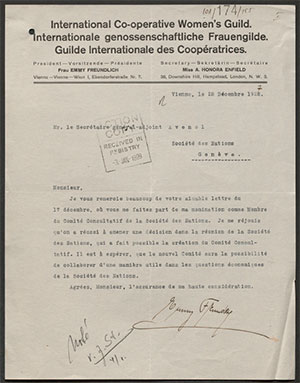
This role was taken very seriously, as evidenced by the oft-heated debates that marked the ECC’s annual sessions. Freundlich, in particular, clashed repeatedly with Clemens Lammers of the International Chamber of Commerce, exposing a fundamental disagreement between the cooperative movement and private business over how industrial concentrations should be regulated. Cooperative representatives favoured a system of oversight exercised by bodies democratically controlled by representatives of workers and producers and, as Freundlich insisted, housewives as well. These bodies would be granted investigative powers to scrutinise the content of industrial agreements, ideally within the framework of a dedicated international convention. Industrial representatives, by contrast, maintained that the role of the international community – and of public authorities more broadly – should be limited to gathering information and studying the phenomenon in descriptive terms.[17]
Under the ECC’s rules of procedure, all decisions had to be reached by consensus rather than by majority vote. This principle, already tested during the Preparatory Committee’s deliberations, ensured that any recommendations emerging from the ECC reflected a wide range of competing interests. The inevitable result was that many of its resolutions were significantly diluted. This feature soon proved to be an inherent weakness of the Committee, particularly once the world economy was engulfed by the crisis of 1929, which dramatically intensified protectionist tensions among governments and deepened the Committee’s sense of powerlessness in the face of an unprecedented situation. Its third session, initially scheduled for May 1930, was repeatedly postponed before the decision was taken to suspend the body altogether, officially on budgetary grounds. The justification struck many as deeply ironic. As Georges Theunis, the ECC’s chairman, remarked bitterly in September 1931: “In the current circumstances… those belonging to business circles have far more important things to do than attend consultative meetings. I am very pleased that the League of Nations can invoke a budgetary argument to avoid a meeting that, given its absolute lack of powers, could not have achieved anything.”[18]
The demise of the ECC was a profound disappointment to Freundlich, who pointed out that it had been the only body within the League of Nations to provide consumers with direct representation. In reality, the Committee’s dissolution merely foreshadowed a broader shift in the relationship between the EFO and transnational expertise. The end of Arthur Salter’s tenure in October 1931 triggered a succession struggle among Britain, France, and Italy. The League Secretariat resolved the dispute in a characteristically diplomatic fashion. Rather than appointing a single successor, it divided leadership among three figures: the Italian Pietro Stoppani at the head of the Economic Section, the British Alexander Loveday leading the Financial Section, and the Frenchman Joseph Avenol overseeing their coordination. The EFO, which had once ambitiously aspired to shape governmental policies, had become increasingly subject to governmental pressures itself.[19]
The new climate was equally evident in the preparations for the International Economic Conference scheduled to convene in London in June 1933. Unlike its predecessor, the conference involved the “Greater League” only to a limited extent. Its Preparatory Committee was composed largely of representatives drawn from the League’s own agencies, signalling a marked retreat from the approach that had characterised the Geneva Conference of 1927.
Legacies of an Unfinished Experiment
Freundlich continued to collaborate with the League of Nations and the International Labour Office in various capacities, particularly during the World Disarmament Conference of 1932-34. Yet her confidence in the League’s ability to assert itself within an international environment increasingly shaped by authoritarianism and militarism steadily waned. By the late 1930s, she had come to advocate a far-reaching reform of the League itself as a last resort for preserving international order.
Concluding Reflections
Freundlich’s experience within the EFO illuminates one of the League of Nations’ most ambitious institutional experiments: the attempt to strengthen international cooperation by grounding political decision-making in transnational expertise, thereby compensating for the organisation’s lack of coercive powers. Through the ECC, the EFO brought together international officials and representatives of non-governmental organisations to create an autonomous space where technical knowledge could temper national rivalries and shape international economic policy. If this experiment ultimately failed, it was largely because the economic and political upheavals unleashed by the Great Depression demanded instruments far more powerful than a consultative body could provide. However, its dismissal should not obscure its significance as an innovative attempt to redefine the relationship between expertise and global governance.
The dissolution of the ECC marked the end of the institutional vision that had inspired Salter’s leadership, exposing the EFO to increasingly direct governmental pressures. Even so, it would be misleading to draw a sharp distinction between an initial phase of EFO autonomy and a subsequent period of governmental domination. Although the organisation’s ties with the “Greater League” weakened, its officials continued to defend the intellectual independence of the international civil service, at times in open disagreement with their own governments. Pietro Stoppani’s refusal in 1937 to endorse Mussolini’s order that Italian officials resign from the League of Nations – insisting that he could “be of some use only in an international environment” – epitomized the enduring strength of this internationalist professional ethos.[20]
The questions first explored within the EFO did not disappear with the ECC, resurfacing in the League’s final years. The 1939 Bruce Report proposed the creation of a Central Committee for Economic and Social Questions endowed with its own budget and independent powers, advancing many of the principles that had informed Salter’s earlier experiments.[21] Although the outbreak of the Second World War prevented these reforms from being implemented, they found more enduring expression in the post-war United Nations system, most notably in the consultative status granted to non-governmental organisations within ECOSOC, including the ICA and the ICWG. Freundlich’s career reveals the EFO – and, more broadly, the League of Nations – as a laboratory for the construction of a transnational knowledge infrastructure, reimagining global governance as a process informed by communities of experts and socio-economic actors alongside states. Although this vision remained only partially realised, it anticipated conceptions of cooperation that would continue to shape international order long after the League itself had disappeared.
References
[1] This blog is part of a broader study of Emmy Freundlich as an international economic thinker conducted within the ERC Advanced Grant project ECOINT – Twentieth Century International Economic Thinking and the Complex History of Globalisation, led by Professor Glenda Sluga. I am grateful to her for making this research possible. I also wish to express my thanks to INNER_LEAGUE for hosting these reflections.
[2] League of Nations Archives (LoNA), League of Nations Secretariat (LoNS), Dossier R531/10C/59579/46431/Jacket2, Report and Proceedings of the World Economic Conference, vol. 2, 168.
[3] For a biographical note, see Samuel Boscarello, ‘International Economic Thinkers-Profile: Emmy Freundlich’, ECOINT IET Profile no. 8, 2024.
[4] Thomas R. Davies, ‘A “Great Experiment” of the League of Nations Era: International Nongovernmental Organizations, Global Governance, and Democracy Beyond the State,’ Global Governance: A Review of Multilateralism and International Organizations 18, no. 4 (2012):405-423.
[5] A respected British civil servant, Arthur Salter had also served as director of the EFO’s predecessor body, the Provisional Economic and Financial Committee, established in 1921.
[6] Sandrine Kott and Davide Rodogno, International Organizations: The historians’ perspective, in Bob Reinalda and Marieke Louis (eds.), Routledge Handbook of International Organization (London: Routledge, 2024):124-136; Perrin Selcer, The Postwar Origins of the Global Environment: How the United Nations Built Spaceship Earth (New York: Columbia University Press, 2018).
[7] Haakon A. Ikonomou, ‘The Administrative Anatomy of Failure: The League of Nations Disarmament Section, 1919–1925,’ Contemporary European History 30, no. 3 (2021):321-334.
[8] Tara Zahra, Against the World: Anti-Globalism and Mass Politics Between the World Wars (New York: W.W. Norton, 2023); Erwin Dekker, The Viennese Students of Civilization: The Meaning and Context of Austrian Economics Reconsidered (Cambridge: Cambridge University Press, 2016).
[9] Jelena Tešija, ‘Millions of working housewives”: the International Co-operative Women’s Guild and household labour in the interwar period,’ Journal of Contemporary Central and Eastern Europe 31, no. 2 (20223):321-338.
[10] Patricia Clavin, Securing the World Economy: The Reinvention of the League of Nations, 1920-1946 (Oxford: Oxford University Press, 2013).
[11] LoNA, LoNS, Dossier R532/10C/47277/46893 - International Economic Conference - Representation of the International Cooperative Women’s Guild on the Preparatory Committee, Albert Thomas to Sir Arthur Salter, 27 October 1925.
[12] Katharina Friberg, A Co-operative Take on Free Trade: International Ambitions and Regional Initiatives in International Co-operative Trade, in Mary Hilson, Silke Neunsinger, and Greg Patmore (eds.), A Global History of Consumer Co-operation since 1850: Movement and Businesses (Leiden, Boston: Brill, 2017): 201-225.
[13] LoNS, Dossier R533/10C/51082/46893/Jacket1 - Comité Préparatoire de la Conférence Economique Internationale - Procès-verbaux de la première session 26 avril-1er mai 1926, Fourth Meeting, 27th April 1926, 3 p.m., 21.
[14] LoNS, File S116/66/3 – General correspondence of Sir Arthur Salter, 1927, Sir Arthur Salter to Georges Theunis, 4 March 1927.
[15] However, in the end, the Soviet Union also appointed two women delegates, Anastasie Bairoulevitch and Xenie Bolschakoff. See the database produced by Sabine U. Selchow, ‘Participants of the World Economic Conference 1927’, ECOINT, 2026.
[16] Report and Proceedings of the World Economic Conference, vol. 2, 163-167.
[17] LoNA, Official Documents (League of Nations), Item 0000765400_D0001, Report of the Economic Consultative Committee on its Second Session, 6-11 May 1929.
[18] LoNA, LoNS, File R2618/10A/16838/154 - Economic Advisory Committee - Arrangements for the 3rd session, Georges Theunis to Pietro Stoppani, 30 September 1931.
[19] Patricia Clavin and Jens-Wilhelm Wessels, ‘Transnationalism and the League of Nations: Understanding the Work of Its Economic and Financial Organisation,’ Contemporary European History 14, no. 4 (2005):465-492.
[20] Elisa Tollardo, Fascist Italy and the League of Nations 1922-1935 (London: Palgrave Macmillan, 2016):221.
[21] Sabine U. Selchow, ‘From “economic and social questions” to national containers and two notions of “political”: findings of a systematic analysis of the symbolic construction of “economic problems” in the League of Nation’s Bruce Report (1939),’ EUI HEC, 2022/07, ECOINT