
INNER_LEAGUE Interview with the Editors of The Cambridge Handbook of the League of Nations and International Law
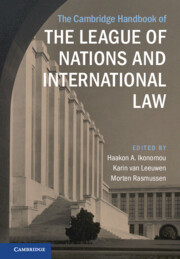
This week we would like to share an interview with Haakon A. Ikonomou, Karin van Leeuwen, and Morten Rasmussen – the editors behind the new Cambridge Handbook.
 |
 |
 |
The book analyses the role of international law in the construction of the League of Nations: the first multilateral organisation to institutionalise global governance and intercontinental cooperation. We think that you will find the editors’ reflections intriguing as they explain how this book came to be and why. Without further ado, here is the inside scoop.
What did you individually contribute to the project of making this book? That is, in relation your academic background, your research interest, and your abilities
Morten: “The Handbook is the final result of a collective DFF project I was leading from 2019 to 2022 Laying the Foundations: The League of Nations and International law, 1919-1945. The aim of the project was to explore the role of international law in the League of Nations as well as the impact on the latter on the development of international law. The project quickly turned into a broad network of scholars from history and law that all worked on the history of the League and international law on basis of archival research.”
Haakon: “I was brought into Morten’s project as an expert on the League of Nations’ administrative and diplomatic history, so I would say that my main contribution was to bring the rich historiography on the League into dialogue with the equally rich literature on the history of international law. Secondly, I had a Gerda Henkel Fellowship on the history of disarmament, so naturally my chapter contribution to the Handbook deals with disarmament and collective security. Finally, we have been lucky to land the final stages of the development and launching of the handbook within the framework of my ERC Consolidator project INNER_LEAGUE.”
Karin: “As a historian of national (constitutional) law and EU law, I brought experience with working across disciplines, questioning from the perspective of a political historian how & where legal ideas and practices impacted historical phenomena that so far merely had been understood through a political lens (in this case: the successes and failures of the League of Nations in the interwar period). Even though international law obviously was a ‘strange country’ to me, this experience helped me to quickly identify and learn its language and understand its customs.”
What kind of new 'case material' do you present in the book? Can you give us an example?
 Morten: "The Handbook is organized in four sections that explore 1) the key institutions of the interwar period dealing with international law including among others the League of Nations and the Permanent Court of International Justice, 2) the most important states, 3) key individuals and transnational networks and finally 4) a number of central policy fields. The aim is in this manner to offer a comprehensive overview of the multiple ways the League of Nations system and international law evolved during the interwar period.”
Karin: “This organization of the book illustrates the many different places where we think ‘international law’ is made and in turn leaves an impact. This isn’t just the product of diplomatic negotiations or courts – even though we also discuss some of those key sites – but also of ad hoc committees of wise men, of legal services, of individuals and their networks, of financial flows or of national public opinion, to name just some sites that are explored further in the book.”
Haakon: “There is plenty of new archival material at use in this Handbook, as it brings together scholars that in various ways have worked with the subject over several years. But I think in terms of cases, I believe the most important thing this Handbook shows is that international law – far from ‘dying’ with the League – found a new institutional anchoring as one of the permeating ‘meta-languages’ of international politics, present in every aspects of multilateralism and across every policy field. In this sense, the interwar period is a bridge into the postwar era and the multifarious second generation IOs that were built then, and which are still with us today.”
How does your book add to the field of literature on legal history and what was your goal with this book?
Morten: “The Handbook is the first comprehensive analysis of the League of Nations and international law from 1919 to 1939. It offers a template and methodology for how to do legal history of the League of Nations, a large number of empirical studies and a historical synthesis. At the very core it offers a new archive based and contextual history on the role of international law in the League of Nations that goes much deeper into how law as a language and legal techniques shaped the establishment of a new system of global governance. In comparison to the traditional history of international law that focuses on doctrines and leading jurists and legal scholars, the stories the Handbook tells are much more messy and show how law was always closely intertwined with politics.”
Karin: “In this more ‘political’ approach to legal history, the book builds on earlier work some of us have done on the history of EU law. While we’ve come to realize that there are vast differences between interwar international law compared to postwar European law, the Handbook nevertheless reflects this broader perspective on law of ‘the international’ – not singling out the League of Nations or international law as such, but studying it in the broader context of the history of global governance Morten already referred to.”
Haakon: “I think the Handbook opens up the array of topics, arenas, actors, and institutional entities that can be understood as using or applying legal techniques as part of a wider set of governance tools in international politics. As such, I believe that the whole Handbook, on the one hand, showcases and documents how this was built into and evolved within the broader League machinery – thus paving the way for how institutionalized multilateralism developed from the postwar years onwards – and, on the other, serves as a tasting menu of future avenues of research for coming generations of historians and legal scholars (hopefully working in tandem).”
Do you each have a favourite chapter in the book?
Morten: “There are many fascinating studies that cover completely new ground. I would highlight Jens Wegener’s wonderful chapter on the Carnegie Foundation that goes into detail with the multiple ways the foundation funded activities of international law and thus very much shaped the development of the field of international law with which the League of Nations had to interact.”
Haakon: “I would perhaps like to highlight Megan Donaldson’s contribution on Law, Legal Expertise and Peaceful Settlement of Disputes within the League Council. First, it really displays what the combination of deep archival research, historical methodology and a legal scholarly approach can offer. Second, it shows the wide spectre of legal instruments and expertise applied in settling disputes, that somehow range from the purely diplomatic to the purely legal – but mostly lies somewhere in-between, and which resides across multiple institutional entities. I also like the granularity of the analysis.“
Karin: “This is a very difficult question as there are so many exciting chapters, some from very junior authors working on their PhD, some from well-established authors, and most of them building on a wealth of yet undiscovered sources! Maybe one personal favourite is Tomoko Akami’s chapter on Japan and international law, which challenges the reader to rethink the history of the PCIJ by zooming in on something that did not happen – a court procedure on the Manchurian crisis. At the same time, the chapter reminds me of the creativity many of us required during the pandemic, when access to sources was not self-evident.”
What do you wish to see more of in the future of the field? Or alternatively, in what direction do you think the research is ‘going’, so to say?
Morten: “I think the new type of legal history we have introduced to the field can ultimately develop into a new deeper understanding of the development of international law in the interwar period. An understanding that goes beyond the neat tales of the gradual progress and accomplishments of international law and instead show how international organisations really used legal language and techniques in their work and what where the limitations of these.”
Haakon: “I hope to see more research that truly works across disciplines to qualify both our historical understanding of international organizations and politics, but also perhaps ‘demythologizes’ some of the meta-languages of global governance in the 20th and 21st century, such as international law and economy, and place them – and their enormous influence on international politics – squarely within their multilateral, political, ideological and organizational context.”
Karin: “While we are certainly not done creating a better understanding of international organisations and politics, I from my side also look forward to better connecting these new insights to national and local histories. What did the arrival of these new legal languages and techniques mean for everyday lives, whether of Kurdish-Turks, Silesian miners, or Dutch Rhine shippers to name just a few examples? Following their stories, we may also need to rethink the impact of the new meta-languages on especially national political contexts.”
A Thank you to Morten, Karin, and Haakon for taking the time to answer each question with such careful reflection as evident in your thorough but precise answers.
If the editors have managed to pique your interest as they have ours, you can now openly access and download the book digitally at Cambridge University Press website.
This interview was conducted by MA student Cecilie R. Myrup from SAXO.
Book Launch: The Cambridge Handbook of the League of Nations and International Law
Join the UN Library & Archives Geneva for the launch of the handbook on 10 July 2026 at 1:45-3 pm in Palais des Nations, Geneva.