
Christianity as common ground: missionaries, international health work, and visions of trusteeship
Blog post by Ida Kaae Antonisen.
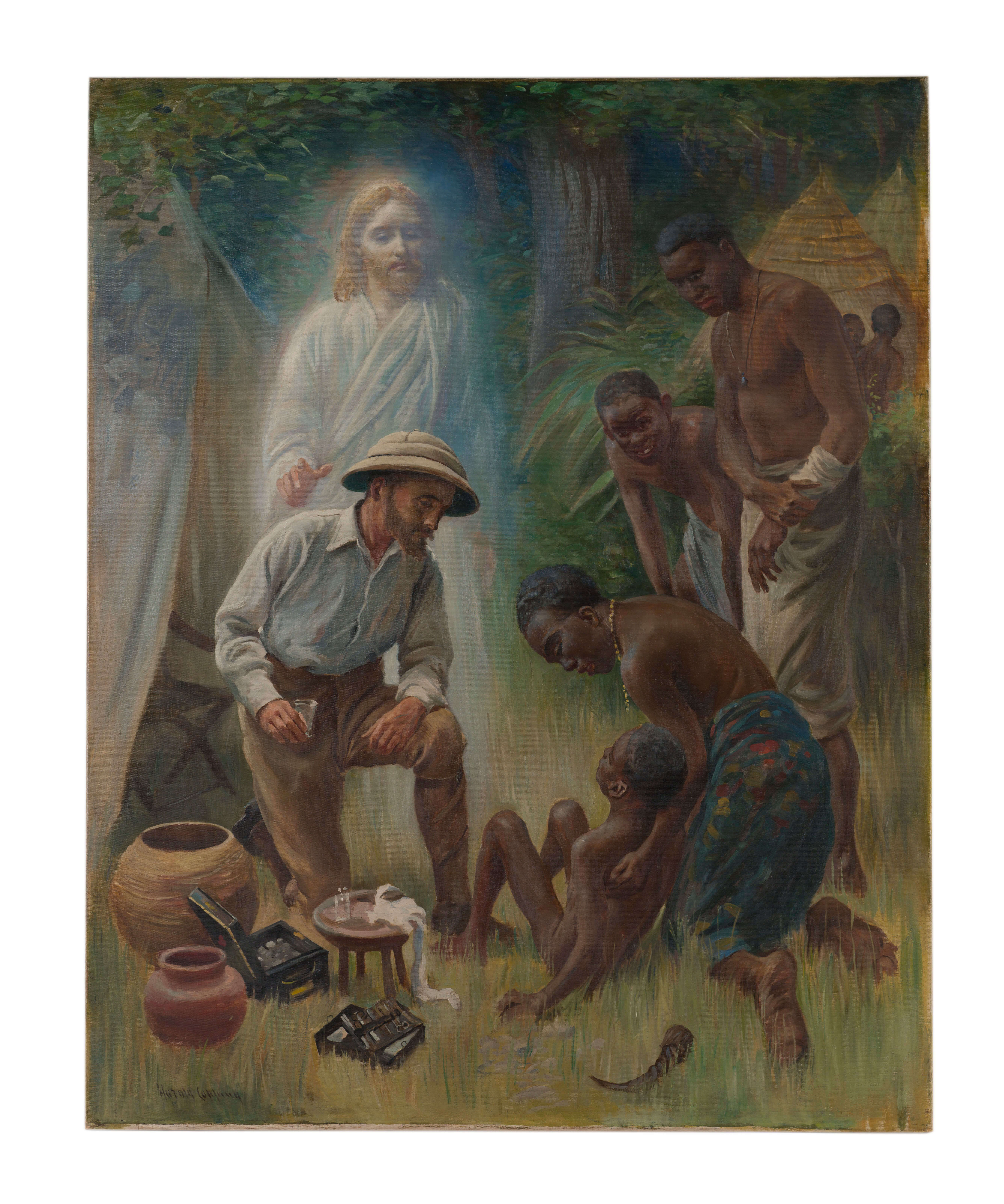
Harold Copping: 'The healer' (1916). Wellcome Collection, 4.0
International (CC BY 4.0).
Often reduced to a vague ‘cultural factor’ in analyses of internationalism, Christianity and its international organisations were, in fact, of interest to the League. Not least from the perspective of the Mandates Section, where the balancing act between international oversight and imperial interests had become more precarious than ever by the late 1920s. In this blog post, I take a close-up look at one particularly telling case from the Secretariat’s extensive engagement with Christian internationalism: the proposal of involving Christian missionaries more closely in League-backed health work in colonial and mandatory Africa. I argue that by virtue of their position as both health workers and carriers of European civilisation, medical missionaries were seen as a potential stabilising factor in the Mandates Section’s balancing act between imperial interests and the broader internationalist vision of the League.
Although Christian influence is not clearly visible at first glance in the work of the League of Nations Secretariat, it is worthwhile to go looking for it. When we discuss the League’s, and particularly the mandates system’s, entanglement with empire, the role of the Christian faith tends to fly under the radar, despite its status as a foundational aspect of European moral and civilisational self-perception. Religion was not written explicitly into the DNA of the League at its inception, though Christian morality was certainly implied in naming its founding document not a mere treaty or agreement but a Covenant, and not least in the article laying out the mandates system as a ‘sacred trust of civilisation’. However, religious matters were not made the subject of formal policies in the work of the Secretariat. But if we take the lack of official procedure as a sign that the Christian faith had no real influence on the organisation, we risk overlooking an important aspect of the League’s moral foundation. Rather, the lack of official acknowledgement of religion meant that Christian influence was able to hide in plain sight. In the following, I argue that much can be gained by attempting to bring into full view the role of Christianity in the belief systems underlying the League, and in the work carried out by the Secretariat.
When trying to understand this matter, I have found that a fruitful course of action is to look at Christian influence on the international landscape at the time. On the one hand as an important ideological component of Wilsonian internationalism, but especially through international Christian organisations as historical actors in the blossoming landscape of international civil society.
Wilson’s belief in the establishment of a League of Nations was rooted in his worldview that the states of the world could be united under American leadership. In recent years, researchers have paid more attention to the fact that Wilson’s vision of unity cannot be separated from his belief that it could only be achieved through superior peoples’ effort to spread shared Christian values to inferior ones.[1] Despite Wilson’s step back from the League after it was created, Christian thought continued to influence the organisation, not least through the Secretariat’s extensive collaboration with international Christian organisations. Throughout its lifetime, the Secretariat interacted with a number of religious organisations, sporadically with some and consistently with others. One of the most influential organisations the Secretariat maintained relations with was the International Missionary Council. In the following, I will take a closer look at both correspondence and internal communications in the Secretariat regarding the idea of fostering closer collaboration between missionaries and mandatory and colonial governments, spearheaded by Huntington Gilchrist, the American Assistant Director of the Mandates Section. The case provides interesting insight into the role Secretariat officials, directly and indirectly, ascribed to Christianity in the work of balancing their own internationalist vision with the interests of imperial and mandatory powers.
International Christianity and the Secretariat
In April of 1928, Huntington Gilchrist noted that he had for the past year ‘been discussing orally and by correspondence in an informal way’ with deputy-director of the Health Section Norman White and with co-secretary of the International Missionary Council Abbe L. Warnshuis ‘the question of a possible combined effort of governments and missionary organisations in Africa against sleeping sickness’.[2] Based on the discussions and the material from missionary societies which the IMC forwarded to the Secretariat, it would seem that the vision was for medical missions to contribute systematically to the health efforts and research of mandatory and colonial governments with personnel, expertise, and statistics.[3] Particularly, Gilchrist and his companions saw great potential in involving medical missionaries in existing efforts by governments and the Health Section to research and combat the spread of trypanosomiasis, or sleeping sickness, which, according to missionaries in the field, was prevalent especially in areas of Congo, Angola, and Uganda.[4] Gilchrist expressed hesitation in engaging with the matter, since he had, in his own words, ‘no technical qualifications whatever as regards the question’.[5] What was it, then, that made him take such an interest in a health campaign?
Gilchrist’s interest would seem to hinge in part on the involvement of the International Missionary Council. Transnational in its nature as it was, the missionary movement was at the centre of Christian internationalism at the time. In the words of Kenneth R. Ross, the 1921 formation of the International Missionary Council at Lake Mohonk, New York ‘gave institutional structure to the ecumenical dream’ which had developed before World War One.[6] Throughout the 1920s, the organisation took a keen interest in social issues and racial relations, and during Easter of 1928, while the organisation was in contact with Gilchrist, the organisation held a conference in Jerusalem which had as a central discussion topic ‘The Christian mission in the light of race conflict’.[7] Thus, compared with organisations preoccupied primarily with theological questions, there was a greater degree of overlap in interests between the IMC and the Mandates Section.
At the same time, the IMC represented what amounted to thousands of Protestant missionaries and their supporters at home, and so wielded considerable influence among sections of the public the Secretariat was eager to have on its side. Emil Seidenfaden has shown how the Secretariat employed a strategy of ‘division of labour’ in its efforts to influence public opinion, drawing on influential private organisations to conduct propaganda on the League’s behalf, in order to avoid compromising its own neutral status.[8] I have previously examined how the Secretariat maintained close relations with numerous Christian organisations, both Catholic and Protestant, using a similar dynamic to influence Christian milieus and to draw on Christian morality and public influence while still maintaining its image of impartiality.[9] I would argue that a similar logic drove Gilchrist’s interest. Medical missionaries represented a seductive combination of the depoliticised, ‘technical’ realm of health work with humanitarian moral sensibilities.[10] As Secretary General Eric Drummond put it in his response to a memorandum Gilchrist wrote on the matter: ‘It is, I think, a fact that of the work which white men do in “backward” countries, the Health work is the least suspect’.[11]
Suspicions have indeed been levelled at the mandates system by contemporary observers as well as modern scholars. While the Permanent Mandates Commission did to some extent provide an arena for contestation of imperial practices, its effects were limited. Susan Pedersen has shown that the PMC’s capacity for normative rhetoric and the scrutiny of an international public pushed colonial and mandatory powers to change the way they talked about colonial and mandatory rule.[12] At the same time, the mandates system did not provide a real reckoning with either imperial practices or the imperial ideology of European civilisational superiority.[13]
Spreading the gospel of European trusteeship
In the memorandum mentioned above, Gilchrist laid out his thoughts on the possible benefits of missionary collaboration. Considering Gilchrist’s viewpoint from inside the Mandates Section, it is not surprising that the memorandum leaves a similar impression of Eurocentric ideas dressed up in internationalist language. After summarising the state of the effort against sleeping sickness and the IMC’s willingness to collaborate, Gilchrist sums up the central appeal of the proposal in his eyes: its potential to ‘be a practical constructive demonstration of the larger international view of European trusteeship for Africa’.[14]
What view is that, according to Gilchrist? In a paper presented by Gilchrist at a meeting of the Geneva Institute of International Relations in August of 1927, he stated that the main difference between imperial sovereignty and the trusteeship engendered by the mandates system was that the administration of territories under trusteeship ‘should be determined by the interests of the natives rather than by those of the Governing Power’.[15] Gilchrist sees ‘civilising work’ as a central tenet of the duty to better the conditions of native populations, highlighting the role of missionaries in this undertaking.[16] In this, Gilchrist mirrors the self-perception of the medical missionaries, who expressed their willingness to cooperate with research workers because ‘their objective is directly and indirectly for the benefit of the native inhabitants’.[17]
For both Gilchrist and the missionaries, the sense of responsibility for the interests and wellbeing of native populations went well beyond physical health. Although medical missionaries with full medical training had existed as a distinct category of missionary workers since the middle of the 19th century, missionary hospitals continued to be organised to encourage conversion of patients, and medical missions were still perceived by missionaries first and foremost as a ‘means of evangelisation ’.[18] From Gilchrist’s perspective, a potential collaboration presented a potent blend of internationalism, Christianity and overall European interests. As he put it:
‘I have become more and more interested in this whole plan because it seems to represent a great opportunity, not only from the public health point of view but from the point of view of the development of international cooperation in Africa, from the point of view of cooperation between the great Christian religious forces in the world and from the standpoint of the development of the attitude of the natives in Africa toward Europeans’.[19]

With his preoccupation with European prestige in the eyes of African populations, Gilchrist echoes a central concern of empire, albeit with an international twist. Gilchrist thus frames the involvement of missionaries primarily as a means of solving some of the challenges faced by mandatory and colonial governments, not just in carrying out their health policies, but in maintaining prestige in the eyes of indigenous populations.[20] He had reason to believe that missionaries might be able to mitigate native pushback against forceful health measures undertaken by mandatory or colonial authorities. A memorandum from a British missionary society forwarded to Gilchrist by the IMC stated that missionaries would be able to supply medical researchers with useful knowledge ‘by virtue of their close touch with the natives, and their knowledge of native language, customs, geographical peculiarities, flora, fauna, etc.’[21] Moreover, missionaries were ‘in an excellent position to carry on an intensive campaign of propaganda along health lines’, including publications of material in vernacular languages and explaining the reasons for heavy-handed health measures such as ‘deportation of natives from their homes in infected districts, or compulsory segregation of sufferers from the disease in camps’, thereby ‘winning the goodwill of the native chiefs and people towards the measures and those whose duty it is to impose them’.[22]
To Gilchrist, the same position that made missionaries attractive collaborators to colonial authorities made them interesting from the perspective of the League. From their vantage point, with access to not only the bodies, but the minds and even the souls of indigenous populations, missionaries had the potential to imbue international technical cooperation with a sense of civilising purpose. I argue that Gilchrist saw missionaries and their ability to bridge this gap as a means of easing some of the tension between the interests of colonial governments and the League’s public commitment to the ideals of international trusteeship.
Risks and rewards of missionary collaboration
Emblematic of his position within an international secretariat, Gilchrist saw great potential in the transnational nature of many missionary endeavours. He argued that, while some governments struggled to recruit colonial medical personnel, missionary organisations might have an easier time providing additional personnel, since they ‘would not be so restricted in their choice as regards nationality as the local administration’.[23] Gilchrist’s internationalist logic was not so easily accepted by missionaries themselves, with a representative of a British missionary organisation positing that missionary societies were ‘of course, much more limited in that they require spiritually-minded persons desirous of being missionaries’.[24]
Gilchrist perhaps read into the work of missionaries a sort of reflection of the ideals of the Secretariat; devoted individuals whose work for a greater cause transcended nationality. At the same time, it is clear that the specifically confessional and evangelising elements of missionary medical work were not an irrelevant by-product to Gilchrist. Rather, he saw missionaries’ position as representatives of ‘the great Christian forces of the world’ as a strength, provided they could put on a united front. Just as the technical nature of health work might mitigate political differences between nations, Gilchrist figured that it might have a unifying effect on missionaries of different confessions, since ‘cooperation would be of a technical type raising no religious questions’.[25] Drummond, himself a Catholic, agreed with Gilchrist that ensuring the support of Catholic missionaries would ‘clearly be of great advantage’, underlining the importance of not ‘appearing to favour one creed or confession rather than another’.[26] Drummond suggested involving Jean Daniel de Montenach, a Swiss member of the Political Section, whose official duties included maintaining relations with influential Catholic communities, to which he had strong personal ties.[27] It would seem that, in addition to missionaries’ usefulness as representatives of European civilisation in Africa, Secretariat officials wished to harness the publicity value missions held through their relations with Christian milieus at home.
The proposal did not receive the same enthusiasm from all quarters. Ludwik Rajchman, the Polish Director of the Health Section, expressed his reservations to Gilchrist, stating that ‘if any international coordination is to be brought about in the field of public health we are the body that should undertake it and not the International Missionary Council’.[28] He had discouraged Norman White from taking the matter further, in practice barring it from being discussed by government representatives at a conference on sleeping sickness planned for the fall of 1928.[29] As a socialist-leaning bacteriologist, it is not surprising that Rajchman was not keen on giving missionaries a more central role. His concern was also one of procedure and information flow, expressing regret that Gilchrist’s memorandum had been sent to the IMC, as he feared ‘it may convey an erroneous impression as to what seems to me to be the official attitude of the Health Section, and, I may add, of the President of the Health Committee’.[30]
Considering the Secretariat’s general preoccupation with managing opinion, information, and its own image, there otherwise seemed to be relatively few reservations towards the proposal. This may, on the one hand, have been due to the fact that the plan never became tangible enough to be discussed formally. At the same time, one can imagine that reservations were outweighed by the appeal of medical missionaries as champions of Western civilisation, not as direct representatives of colonial or mandatory administrations, but dressed in the neutral garb of technical cooperation and humanitarianism. So long as the Secretariat had reason to believe that stronger engagement with missionaries would further its aims both in Africa and at home in the ‘least suspect’ way, it might be worth the possible headaches of involving an independent outside party in the League’s cooperation with governments.
Conclusion
The type of formal collaboration Gilchrist had envisioned never came to fruition, mostly due to uncertainty between governments and missionary societies over who would provide funding. Gilchrist had great expectations for missionary societies’ ability to raise funds, remarking that he had ‘been impressed during my recent trips to the United States by the way in which the sleeping sickness problem has been played up to the general public by interesting readable articles even in the cheap five-cent magazines’.[31] At the same time, Warnshuis was in contact with the president of the Carnegie Corporation, though it would seem nothing came of the connection.[32] In the end, the verdict was that neither the missionary societies nor the involved governments were likely to agree to a collaboration unless the other party could guarantee funding. As W. Paton, Warnshuis’ co-secretary at the IMC, put it, ‘the situation looked as if everyone was waiting for someone else to start!’.[33] Even if the proposal of systematic missionary collaboration was not pursued in practice, however, the Secretariat’s considerations around it are nevertheless highly telling of how enmeshed it was in Eurocentric worldviews.
Just as it can be tempting today to reduce Christian missions of the past to mere instruments of imperialism, it would be easy to assume that the work of missionaries was not on the radar of the internationally-minded officials of the Secretariat. While there were reservations towards the proposal, the religious aspect of missionary health work was not seen only as a compromising feature which aligned missionaries with imperialism. Rather, Christianity was seen as a potential source of much-needed common ground between the internationalist vision of the League and the interests of mandatory and colonial governments.
The fact that religious matters were not the object of an official policy in the Secretariat makes it easy to overlook the role of religion outright in the bureaucratic machinery, just as its role is often overlooked in the international landscape at large. The case of the medical missionary collaboration that never was is just one example of what may come to light if we go looking for it anyway. When it comes to the League of Nations Secretariat, the fact that decisions on religious matters had to be made on a case-by-case basis makes religious organisations a useful lens, as interactions between the two lay bare some of the thought processes and worldviews guiding bureaucratic processes within the Secretariat. Even if religious influence is not always immediately visible when we are trying to understand internationalism, it might be worthwhile to shift our perspective to bring it into view. Chances are, it’s there somewhere.
Notes
[1] Jeremy Menchik, ‘Woodrow Wilson and the Spirit of Liberal Internationalism’, Politics, Religion & Ideology 22, no. 2 (2021): 233; Cara Lea Burnidge, ‘Woodrow Wilson’s Christian Internationalism and the Pursuit of a Just and Lasting Peace’, Soundings: An Interdisciplinary Journal 101, no. 3 (2018): 228–29.
[2] Huntington Gilchrist, ‘Memorandum on International Campaign Against Sleeping Sickness’, 25 April 1928, R5854/8A/687/687, p. 180, League of Nations Archives, Geneva.
[3] Cook, ‘Memorandum on Co-Operation Between Missions and Research Workers in the Mission Areas’, n.d., R5854/8A/687/687, pp. 156–58, League of Nations Archives, Geneva.
[4] ‘Extracts from Letters Re Sleeping-Sickness’, 1 June 1928, R5854/8A/687/687, pp. 160–65, League of Nations Archives, Geneva.
[5] Huntington Gilchrist, ‘Note to Eric Drummond’, 27 April 1928, R5854/8A/687/687, p. 179, League of Nations Archives, Geneva.
[6] Kenneth R. Ross, ‘Disciples and Pilgrims, Arusha, and Karlsruhe: Friends or Strangers?’, International Review of Mission 112, no. 1 (May 2023): 15.
[7] The Christian Mission in the Light of Race Conflict, Report of the Jerusalem Meeting of the International Missionary Council, March 24th.-April 8th., 1928, vol. IV (Oxford University Press, 1928), World Council of Churches Archives and Library.
[8] Emil Eiby Seidenfaden, Informing Interwar Internationalism: The Information Strategies of the League of Nations, Histories of Internationalism (Bloomsbury Academic, 2024), 51–56.
[9] Ida Kaae Antonisen, ‘Bureaucracy in Good Faith. The League of Nations Secretariat’s Interactions with International Christian Associations in the 1920s’ (unpublished Master’s thesis, Saxo Institute, University of Copenhagen, 2025).
[10] See Sunil S. Amrith, ‘Internationalising Health in the Twentieth Century’, in Internationalisms. A Twentieth-Century History, ed. Glenda Sluga and Patricia Clavin (Cambridge University Press, 2016), 245–54.
[11] Eric Drummond, ‘Note to Huntington Gilchrist’, 28 April 1928, 178, R5854/8A/687/687, League of Nations Archives, Geneva.
[12] Susan Pedersen, The Guardians: The League of Nations and the Crisis of Empire (Oxford University Press, 2015), 51–52, 65–66.
[13] Susan Pedersen, ‘An International Regime in an Age of Empire’, The American Historical Review 124, no. 5 (2019): 1676–77.
[14] Gilchrist, ‘Memorandum’, 25 April 1928, 183.
[15] Huntington Gilchrist, Imperialism and the Mandates System, (New York), 1928, 11, Columbia University Libraries.
[16] Gilchrist, Imperialism and the Mandates System, 4, 27.
[17] Cook, ‘Memorandum on Co-Operation Between Missions and Research Workers in the Mission Areas’, 156.
[18] Thomas Cochrane, ‘Foreword’, in A Directory of Medical Missions, ed. A.J. Streeter and Thomas Cochrane (World Dominion Press, 1927), 78, R5854/8A/687/687, League of Nations Archives, Geneva; David Hardiman, ‘Introduction’, in Healing Bodies, Saving Souls. Medical Missions in Asia and Africa, ed. David Hardiman (Brill, 2006), 15–18; see also Megan Vaughan, Curing Their Ills. Colonial Power and African Illness (Polity Press, 1992), ch. 3.
[19] Gilchrist, ‘Memorandum’, 182–83.
[20] Gilchrist, ‘Memorandum’, 183.
[21] Cook, ‘Memorandum on Co-Operation Between Missions and Research Workers in the Mission Areas’, 157.
[22] Cook, ‘Memorandum on Co-Operation Between Missions and Research Workers in the Mission Areas’, 157–58.
[23] Gilchrist, ‘Memorandum’, 181.
[24] H. Weir, ‘Letter to W. Paton’, 1 June 1928, R5854/8A/687/687, p. 154, League of Nations Archives, Geneva.
[25] Gilchrist, ‘Memorandum’, 183.
[26] Eric Drummond, ‘Note to Huntington Gilchrist’, 28 April 1928, R5854/8A/687/687, p. 178, League of Nations Archives, Geneva; Gilchrist, ‘Memorandum’, 182.
[27] ‘Personnel File of Jean Daniel de Montenach’, n.d., S837/142/2496, p. 101, League of Nations Archives, Geneva; see also Cormac Shine, ‘Papal Diplomacy by Proxy? Catholic Internationalism at the League of Nations’ International Committee on Intellectual Cooperation, 1922–1939’, The Journal of Ecclesiastical History 69, no. 4 (2018): 785–805, Cambridge Core; Antonisen, ‘Bureaucracy in Good Faith. The League of Nations Secretariat’s Interactions with International Christian Associations in the 1920s’, 21–23.
[28] Ludwik Witold Rajchman, ‘Note to Huntington Gilchrist’, 7 June 1928, R5854/8A/687/687, p. 70, League of Nations Archives, Geneva.
[29] Rajchman, ‘Note to Huntington Gilchrist’, 70.
[30] Rajchman, ‘Note to Huntington Gilchrist’, 69.
[31] Huntington Gilchrist, ‘Note to Ludwik Rajchman’, 11 June 1928, R5854/8A/687/687, p. 67, League of Nations Archives, Geneva.
[32] Gilchrist, ‘Note to Eric Drummond’, 179; Gilchrist, ‘Note to Ludwik Rajchman’, 67.
[33] W. Paton, ‘Letter to Norman White’, 6 May 1929, R5854/8A/687/687, p. 4, League of Nations Archives, Geneva.